The most significant decisions at the highest level of power are seldom made in an audible manner. These choices occur in silence, behind the scenes, under pressure, well outside the reach of conventional collective opinion.
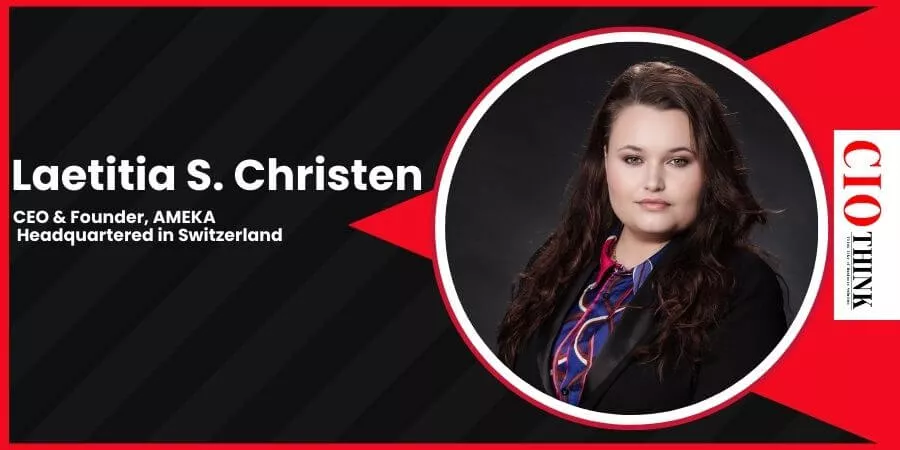
Laetitia S. Christen works in a world that few will ever glimpse, let alone dare to enter, in an age of uncertainty, hyper information and an ever-increasing pressure cooker atmosphere at the summit. As the Founder and CEO of AMEKA, she collaborates with diplomats, senior executives, and high-level decision-makers during moments in time when lucidity is not an option, confidentiality is key and the price of mismatch is permanent.
Not through visibility, performance, or persuasion; her work does not depend on these. Rather, it focuses on repairing what she calls strategic clarity, the ability to see, choose, and do the right thing under conditions when complexity is likely to subvert good judgment. In a world where addicted to speed and noise, Laetitia´s influence moves gently, rooted in coherence, not control.
This is what underpins her work, not only frameworks but presence, discernment and a profound respect for the inner structures of leadership. Before stepping into the mechanics of her work it is important that I share what philosophies make it up.
THE CALLING BEHIND THE WORK
Laetitia, your work operates in rare and highly confidential spaces. What first called you to support leaders carrying the weight of complex, high-stakes decisions?
Very early on, I noticed something most people don’t see: behind authority, titles, and success, there is often profound solitude. Leaders are surrounded, yet fundamentally alone when it comes to decision-making. What called me was not the desire to advise, but to hold a space where truth could surface without distortion. I was naturally sought out during moments when decisions were irreversible, reputations were at stake, or silence was required. Over time, it became clear that my role was not to add pressure, but to restore clarity where complexity had become overwhelming.
You describe your role as restoring “strategic lucidity.” How do you personally define lucidity in leadership?
Lucidity in leadership is the ability to see clearly without being emotionally hijacked or mentally congested. It is not speed, nor intellect alone. It is the moment when a leader can distinguish between fear-driven urgency and true strategic necessity. For me, lucidity is when a decision feels both calm and precise, when the mind is sharp, intuition aligned, and the body no longer resisting the choice. That state is rare, but once accessed, it changes everything.
Many consultants focus on frameworks and methodologies. Your work emphasizes presence and discernment. How did this approach evolve?
Frameworks are useful, but only once clarity is already present. In my experience, leaders don’t lack information; they lack internal silence. No method works when the decision-maker is internally fragmented. Presence became the foundation. Discernment followed. From there, strategy becomes almost obvious. My work doesn’t replace tools, it repositions them after alignment, where they finally become effective instead of performative.
What did your early journey teach you about power and responsibility in decision-making roles?
It taught me that power without alignment is unstable and often destructive. The most costly mistakes I observed were not caused by lack of competence, but by inner dissonance, acting against one’s deeper knowing for the sake of control, speed, or external validation. True responsibility is not about having answers, but about being willing to pause, listen, and choose from coherence rather than pressure.
STRATEGIC CLARITY & LEADERSHIP UNDER PRESSURE
What most often clouds clarity for leaders under constant pressure?
Not pressure itself, but unexamined loyalty, to expectations, roles, and past decisions that no longer fit present reality. Leaders manage complexity outwardly, yet are rarely given permission to question the internal narratives driving their choices. That silent accumulation eventually distorts perception.
When leaders feel overwhelmed, what is usually the first truth that must surface?
Almost always, it is this: not everything requires an immediate response. Once that lands, urgency loosens its grip and discernment can return. Silence is not avoidance; it is often the most strategic act available.
How does a neutral, non-directive space change decision quality?
It removes the need to perform intelligence, certainty, or authority. When leaders are no longer influenced, corrected, or subtly steered, they reconnect with their own judgment. Decisions made from that place are more durable, less reactive, and aligned with long-term consequences rather than short-term optics.
What distinguishes leaders who endure from those who collapse under pressure?
Enduring leaders know when to pause. Those who collapse often confuse endurance with constant output. Leaders who last respect internal signals, recalibrate before exhaustion sets in, and understand that clarity is a renewable resource, if it is protected.
CLAIRVOYANCE AS A STRATEGIC TOOL
Your role as a Strategic Clairvoyance Consultant challenges traditional norms. How do you explain this work?
Very simply: I don’t tell leaders what to decide, I help them see what they already know but cannot yet access clearly. Strategic clairvoyance is not prediction or mysticism; it is the capacity to perceive underlying dynamics before they fully materialize. Most leaders recognize this immediately, because they already operate intuitively, they just haven’t been given language or structure for it.
How do discernment and energetic insight complement rational analysis?
Rational analysis answers how to proceed. Discernment answers whether one should proceed at all. Energetic insight highlights friction or latent coherence that data cannot yet capture. Combined, analysis becomes more accurate, not less. Logic is not bypassed; it is placed within a wider field of perception.
What misconceptions exist about intuition in executive environments?
That it is vague or unreliable. In reality, refined intuition is highly precise—it simply operates faster than conscious reasoning. Another misconception is that it opposes rigor. In fact, the most disciplined leaders I work with are also the most intuitive; they simply don’t publicly name it.
DISCRETION, TRUST & ETHICAL INFLUENCE
How do you cultivate absolute discretion with high-level decision-makers?
Discretion begins long before words are exchanged. I don’t collect stories, names, or outcomes, and I don’t leverage proximity to power for visibility. Trust is built through consistency, silence, and certainty that nothing shared will ever be repurposed. Over time, discretion becomes a shared understanding rather than a promise.
Why is simplicity essential in your consulting philosophy?
Because complexity already exists in abundance. Under pressure, additional structures often create more noise. Simplicity restores orientation. It removes what is unnecessary so that what truly matters can emerge. It is precision without excess.
RECOGNITION, LEGACY & THE FUTURE
What did recognition from IAOTP mean to you at this stage?
It felt like a quiet acknowledgment rather than a milestone. Recognition matters less than alignment. What I valued most was that the work was honored without requiring exposure. It confirmed that impact does not need amplification to be real.
What legacy do you hope your work leaves?
I hope it leaves leaders more sovereign in their thinking. If institutions become more stable, decisions more ethical, and power less reactive because someone paused and saw clearly, that is enough. Legacy is measured in what did not collapse.
Finally, what is the one truth every leader must reconnect with to lead wisely?
That clarity precedes authority. Without it, power destabilizes. With it, leadership becomes service rather than force. Everything meaningful begins there.
Where Influence Moves in Silence
Laetitia S. Christen has never earned her stripes as an entrepreneur and creator through traditional means or sexiness. Her work spans several paradigms: a lifetime artistic curve, deep in private consulting with high-level leaders engaging the complexities of systems, and impact work that emerges uniquely through intuition, strategy, and discernment based solutions that were constructed beyond the industrial paradigm of “success” that have provided a lot of the current narratives of our world.
The sensitivity that once looked like a weakness (and was mistakenly used against her) is now one of her most powerful strengths. This depth of perception allows for clarity under pressure, ethical influence, and a leadership based on coherence not coercion. Now on the ground, she has intentionally made the choice to not be a profile subject, to focus on getting things done quietly instead of in the spotlight, and to design systems that survived leaders and times, not just personalities.
This subtle yet real influence was officially recognized in 2026 as she was awarded Top Global Personal Consultant of the Year based on merits of excellence in confidential advisory work, strategic clarity, and ethical leadership. Instead of signaling an arrival, the accolade validated a path characterized by trust, Hidden Hand, long-termism, not visibility.
Heroes to come: what She does points to another way of being led, one based on equanimity, alignment and humanity as opposed to the noise of fear. A future where women are unoppressed to create success models that are true to their own identity rather than a notion of what is expected or even performing what is expected of them.
In Laetitia S. Christen, we found a different narrative around power, influence based not on noise but rather on lived experience, inner sovereignty and calm strength.