
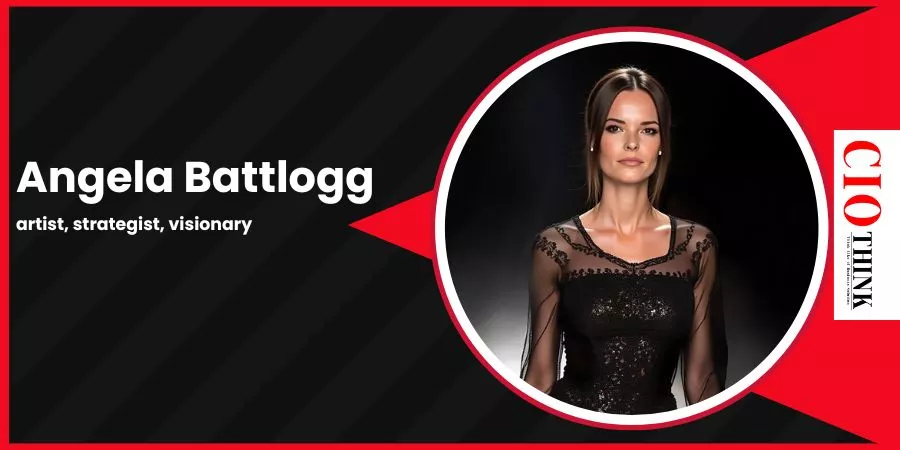
Most organizations don’t fail abruptly. They drift. Performance continues, targets are met, dashboards remain green. Yet beneath that activity, alignment weakens. Departments optimize locally, decisions grow reactive, and incentives begin to pull in different directions. On reports, everything appears functional. In practice, coherence thins.
Angela Battlogg reads organizations as interconnected systems of incentives, behaviors, and measurable outcomes. When structure continues but meaning detaches from execution, she identifies where misalignment has taken root. Often, something functions operationally yet lacks cohesion. By tracing how decisions translate into structure and how structure shapes performance, she makes structural gaps visible. Her strength lies not in enforcing change, but in restoring shared understanding between intention, metrics, and lived behavior.
Reading Systems Between the Lines
Angela first became aware that she was operating on multiple levels when she entered professional environments and noticed how differently she perceived them. While fluent in numbers, strategy, and structure, she also tracked the behavioral consequences those structures produced. She questioned why inefficiencies were tolerated, why certain systems remained unquestioned, and why organizations routinely sidelined what could not be neatly measured. Over time, a pattern became clear: metrics do not merely reflect performance, they shape it. What challenges established indicators is often suppressed, not because it lacks value, but because it destabilizes existing frameworks. That realization marked a turning point. Angela understood she was reading systems simultaneously as they were documented and as they actually functioned in practice. Metrics may align on paper, but performance is lived in behavior. And no organization plays the game on paper.
Imagination as an Early Language
Angela’s formative years moved between Austria and California, shaped by immersive worlds that encouraged play, symbolism, and narrative structure. The influence of Disney, Marvel, and Nintendo was never about the franchises themselves, but about the cognitive state they activated. These environments cultivated curiosity and exploration unconstrained by predetermined outcomes.
Long before she identified as an artist, Angela understood that visual language and symbolism are not decorative elements but fundamental tools humans use to orient themselves within complexity. Later, within professional and organizational settings, she recognized the same mechanics at work. What endured was her ability to access that childlike curiosity deliberately. She observed that when individuals lose this state, their thinking becomes rigid, and when they reconnect to it, adaptability returns. For Angela, joy remains a reliable signal of internal coherence.
Reclaiming What Is Called Unrealistic
Angela views the label as unrealistic as a misunderstanding rather than a flaw. What is dismissed often simply has not been accounted for within existing models. Many organizations repeat familiar patterns not because they are effective, but because deviation requires confronting uncertainty. For Angela, reclaiming imagination is an act of resistance against inherited structures that no longer serve. Imagination allows assumptions to be questioned and rigid problems to be reframed. In her work, imagination is never detached from reality. It is grounded in skill, learning, and practical understanding. Without that grounding, it dissolves into fantasy. When integrated, it enables solutions that linear thinking alone cannot access.
When the Body Forces Awareness
At seventeen, Angela was confronted with the possibility that her life could be significantly shorter than expected. The assumption of an open-ended future disappeared. Time became finite and tangible, no longer something to take for granted. External expectations lost relevance, replaced by an acute focus on what mattered. There was little space for prolonged reflection. The choice was immediate and stark: withdraw or continue engaging fully with life. Purpose ceased to be theoretical and became something lived in the present.
Choosing Engagement Over Retreat
Standing still was never an option. Angela was placed into her first leadership role at a young age, managing others not from readiness, but from necessity and alignment. Rather than pulling back, she chose deeper participation. That choice guided her toward education, responsibility, and long-term thinking instead of fear-based reaction. This orientation led her to decisions that appeared unconventional. She left stable roles, returned to formal studies later in life, and took extended sabbaticals that defied conventional career logic. These choices were not acts of rebellion, but expressions of coherence. Creativity and learning consistently restored her clarity and energy. More than a decade beyond the limitations once projected onto her, Angela’s lived reality contradicted those assumptions entirely.
Consciousness, Curiosity, and Pattern
Living within contradiction at a young age sharpened Angela’s awareness of friction points. While she was encouraged to reduce activity and prepare for limitation, she was simultaneously assuming greater responsibility. This distance allowed her to separate her internal signal from external expectation. Once time could no longer be assumed, she stopped spending it unconsciously. Curiosity became essential. Philosophy and consciousness emerged not as abstract interests, but as practical tools for thinking clearly and living deliberately. Over time, Angela observed how deeply narrative and belief shape experience. She began to recognize recurring patterns across people, systems, and time. Constraint, she observed, is often sustained by stories accepted without question. Revising those stories is where meaningful change begins.
Where Organizations Lose Their Soul
Working across sales, finance, marketing, design, and strategy showed Angela that organizations do not lose their soul through growth. They lose it when meaning becomes separated from structure. When metrics, processes, and incentives operate without shared orientation, people optimize locally instead of thinking systemically. Angela sees organizations as living systems rather than static structures, and living systems require coherence across their parts. When targets are not interwoven across teams and reflected in daily decisions and numbers, responsibility fragments. Departments begin to protect their own indicators instead of serving a shared purpose. Internal competition quietly replaces collaboration. Goals may still look aligned on paper, but people rarely see how their work contributes to an overarching objective. What remains may satisfy reporting requirements, yet daily decisions reveal the real structure. Healthy systems integrate meaning into structure. When people understand why something exists and how their work contributes to it, performance and coherence follow. When that link disappears, no amount of optimization can compensate.
Execution in the Absence of Sense
For Angela, meaning functions as an organizing principle. Systems begin to fail when meaning weakens because decision-making becomes opaque. When people no longer understand why decisions are made, execution turns mechanical. Without a shared reference point, decisions become reactive and fragmented. This often reveals a confusion between management and leadership. Management focuses on targets and performance within defined boundaries. Leadership holds the wider context. It connects departments, understands interdependencies, and keeps purpose visible across the system. In many organizations, communication flows upward rather than across. Decisions are justified to the next level instead of integrated with those expected to carry them forward. Teams may meet targets, yet ownership weakens because context is missing. Systems do not fail because people stop performing. They fail because people stop understanding what they are performing for.
The Courage to Create Selectively
Angela’s ability to move from first spark to finished brand shaped her understanding of creative leadership. Creativity and execution are inseparable. An idea only becomes valuable when it can be translated into structure. That requires understanding the wider system around a project, including financial planning, controlling, and sequencing. Financial discipline is not a limitation of creativity, but part of its responsibility. She chooses her collaborators deliberately. The underlying “Why” must align for everyone involved. For Angela, collaboration means contributing from areas of strength while remaining open to growth. The ideas of a production partner are as relevant as those of a technical developer. Creative leadership does not work when one person decides and others execute in isolation. It works when people are included in the thinking, understand the reasoning behind decisions, and share ownership of outcomes. From a strategic perspective, this only succeeds when the numbers make sense and decisions remain economically coherent. When creative and financial logic align, results become not only stronger, but more resilient. That is the collaborative structure she believes will increasingly shape the future of organizations.
Where Intuition and Analysis Converse
Angela does not experience intuition and analysis as opposing forces. For her, they serve distinct but complementary roles. Intuition provides direction and timing, while the analytical mind offers structure, skill, and execution. Imbalance only occurs when one is asked to replace the other. To maintain harmony, Angela creates intentional space for playful, open-ended exploration in her studio. These moments are unscheduled and free from optimization. She works across paper, canvas, and digital tools, allowing ideas to move without predetermined outcomes. This practice keeps intuition active and responsive. Fragments that emerge often resurface later, informing strategic thinking, design decisions, or larger artistic work. In that sense, intuition and skill are constantly in dialogue. One generates direction, the other gives it form. That ongoing exchange is how she maintains balance.
Valuing the Sense of Inner Alignment
For Angela, readiness emerges through synthesis rather than speed. It requires enough quiet to accurately perceive what is present. When external noise is reduced and attention remains grounded in direct experience, patterns become legible. Over time, her ability to connect the dots became a trained capacity, closely tied to pattern recognition. When recurring structures are recognized across domains such as art, business, technology, and economic systems, it becomes possible to see where something genuinely new can emerge. Innovation, in her view, happens at the intersection of creative strategy, pattern awareness, and present clarity. It does not feel urgent or pressured. It feels calm, coherent, and grounded. That sense of structural alignment is how she knows something is ready.
Making Space for Work That Matters
Angela does not engage in creation for attention’s sake. Meaningful work, for her, demands responsibility, alignment, and the willingness to slow down. She is selective about the projects she accepts, choosing only those she can fully stand behind. Creative work always carries impact, shaping perception, behavior, and values. That awareness requires alignment not only with the output, but with the systems and intentions surrounding it. Fast, pressure-driven work disrupts coherence. Without full presence and commitment, creativity becomes exhausting rather than generative. Choosing carefully is not about doing less, but about contributing intentionally and creating work that carries depth rather than noise.
Coherence as the Measure of Progress
Technology amplifies intention. If the underlying model is extractive, technology accelerates extraction. If the model is coherent, technology can amplify intelligence, efficiency, and long-term value. What technology ultimately scales is determined by what a system measures and rewards. For Angela, conscious design means thinking beyond short-term optimization. It requires understanding second- and third-order effects, how systems shape behavior, decision-making, and incentives over time. In an era of acceleration, conscious design is less about doing more and more about scaling what actually makes structural sense. Within organizations, this often means resisting the impulse to add more tools, dashboards, or processes, and instead simplifying systems so people can clearly see how their work connects to the whole. Much of her creativity lives in defining meaningful metrics that reflect what truly matters, not just what is easy to measure.
The Role of Creativity in Times of Transition
As values shift and economies reorganize, Angela sees art and creative strategy as tools of orientation rather than expression alone. In periods of change, people seek ways to make sense of complexity before translating it into action. Creativity becomes a shared human capacity, not a specialized role. Creative strategists help make emerging signals visible, translating perception and meaning into forms others can engage with. Their task is not to dictate direction, but to create conditions where collective understanding can arise. Creativity, for Angela, shapes how people think, build, communicate, and relate. When individuals reconnect with this capacity, they recognize themselves as active contributors rather than passive participants.
Where Safety Allows Truth to Surface
Nothing meaningful emerges under pressure. Angela helps individuals move away from forcing predefined outcomes by prioritizing clarity and psychological safety first. Vulnerability cannot exist without safety, and genuine insight rarely appears in environments dominated by urgency or defense. Creating conditions of comfort and clarity is not only central to her work; it shapes how she thinks, communicates, and leads. She intentionally establishes spaces where unfinished ideas are welcome and assumptions can be questioned without immediate justification. This environment is not accidental. It requires presence, trust, and emotional intelligence. Compassion and openness are not soft qualities in this context; they are operational skills. Without them, insight remains superficial. With individuals, she sometimes describes the process as following joy, not as motivation, but as a signal of internal coherence. In strategic contexts, she examines history, values, constraints, and unspoken assumptions to reveal where alignment is missing. From that foundation, what emerges can be translated into practical, grounded, and economically coherent action that people genuinely own.
The Quiet Power of Seclusion
Seclusion gives Angela signal clarity. It creates distance from constant input, expectation, and reaction, making it easier to distinguish what is genuinely hers from what has been absorbed from the outside. Without that distance, noise can easily masquerade as direction.Over time, she came to treat periods of withdrawal as structural resets rather than interruptions. She now integrates this rhythm consciously through extended sabbaticals, often lasting close to a year. During these phases, productivity gives way to presence. Days are less governed by the clock and more by attentiveness. Seclusion is not retreat from life, but recalibration within it. After sustained quiet, engagement returns naturally, often in the form of studying a new field or committing deeply to a larger body of work. This alternation between stillness and immersion protects the coherence of her creative vision.
Listening Beyond the Noise
Solitude taught Angela discernment. When comfort with oneself grows, selectivity follows naturally. Choices become calmer, guided by alignment rather than expectation. Silence, for her, is not the absence of sound, but a shift in relationship to it. Noise loses its sharpness when it is no longer resisted. This perspective fosters a grounded presence and reveals what feels aligned and what quietly drains energy. Discernment becomes lived clarity rather than analysis.
Symbols as Orientation
Angela’s Cosmic Tarot Deck reflects her fascination with symbols and archetypes as tools for orientation. Archetypes compress complex human experiences into forms that can be intuitively understood. Their persistence across cultures and eras makes them stabilizing reference points when familiar structures dissolve. Her deck is not about prediction, but about reflection. It creates dialogue between conscious thought and deeper perception, offering orientation rather than control.
Vision as Attentive Presence
Being visionary, for Angela, has little to do with visibility or foresight. It is about perception. Vision arises from paying close attention to the present, noticing what no longer works even when it is still accepted. It requires patience, responsibility, and the ability to hold uncertainty without rushing toward simplification. Visionary work is quiet, observational, and long-term. It reveals what is already forming beneath the surface and acts only when direction becomes clear.
The Truth She Hopes Endures
Angela hopes readers leave with a simple understanding: clarity matters more than certainty. In times of structural change, the impulse to force quick stability often produces more confusion. Clear thinking, honest communication, and responsible action are more reliable than rigid plans. Not everything needs to scale immediately. Not everything needs to be optimized. Some things need to be understood before they are expanded. Systems built without understanding eventually create friction. Meaningful work emerges when intention, structure, and behavior are aligned. In periods of transformation, that coherence becomes more dependable than prediction. Clarity does not eliminate uncertainty, but it makes direction possible.