
Where Technology Meets Human Dignity
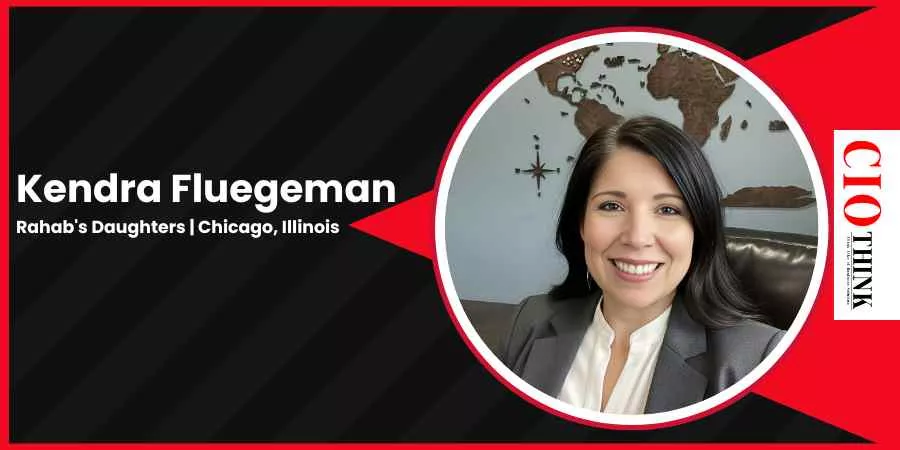
Kendra Fluegeman’s leadership journey lives at the intersection of enterprise innovation and humanitarian advocacy. With more than 13 years of experience in enterprise B2B software and digital transformation, she has led organizations through complex technological change, large-scale system modernization, and high-stakes executive initiatives. Yet what sets her apart in 2026 is not simply her professional expertise, it is how she has chosen to use it.
Throughout her career in fast-paced technology environments, Kendra developed a deep understanding of how systems shape behavior, how data influences decision-making, and how digital transformation can redefine entire industries. But behind every platform, every dataset, and every corporate strategy, she recognized something often overlooked: real human lives are affected by the systems we build.
That awareness became more profound through her work with Rahab’s Daughters, an anti-human trafficking organization headquartered in Chicago. As a board member supporting initiatives focused on Rescue, Rehabilitation, and Reintegration, she encountered firsthand the realities of exploitation, how traffickers manipulate vulnerability, how systemic gaps allow injustice to persist, and how resilient survivors can be when given support and opportunity.
This dual exposure, to enterprise-level innovation and to frontline humanitarian advocacy—reshaped her understanding of leadership. It reinforced her belief that technology and business should function as forces for protection rather than harm. In a world increasingly driven by digital infrastructure, she believes leaders must ask not only “Can we build this?” but “Should we and who does it protect?”
Her leadership is grounded in the conviction that growth without accountability is dangerous. Systems without ethics can amplify harm. Innovation without empathy can widen inequality.
For Kendra, leadership is about designing structures that safeguard dignity.
Redefining Leadership Beyond Career Milestones
Early in her career, leadership was defined by measurable milestones, revenue growth, enterprise expansion, successful digital transformations, executive trust. Those achievements mattered, and she excelled within them. But over time, something shifted.
As her expertise in technology began intersecting with her advocacy work, she realized that professional success alone felt incomplete. She saw clearly how data could either be used to detect trafficking patterns or be exploited to enable criminal networks. She saw how artificial intelligence could be harnessed for digital safety or misused in ways that exposed children to risk.
That realization changed her definition of leadership.
Leadership, she came to understand, is not simply about influence, it is about responsibility. It is about how you use your knowledge, power, and access to protect the vulnerable and create structural change.
Working alongside Rahab’s Daughters brought clarity to that calling. The organization’s mission to combat trafficking through comprehensive survivor-centered programs illuminated a broader truth: leaders in business hold immense capacity to shape safer ecosystems. Corporate influence, supply chain oversight, responsible AI, and ethical data use all have direct implications for human safety.
In today’s business climate, where companies operate globally and technology scales instantly, leaders cannot afford to separate profitability from accountability. For Kendra, making a difference means embedding ethics into innovation and ensuring that growth does not outpace conscience.
Leading Transformation with Integrity and Trust
With more than a decade of experience guiding enterprise organizations through digital transformation, Kendra has learned that change is fundamentally human before it is technical.
Organizations do not change, people do.
The most successful transformations she has led were not defined by software implementation alone. They were defined by mindset shifts, cultural evolution, and trust-building. She emphasizes clarity, transparency, and purpose. Teams must understand not only what is changing but why it matters.
In high-stakes executive environments, emotional intelligence has been essential. As a woman navigating male-dominated tech spaces, she has faced implicit bias, skepticism, and moments of being underestimated. Rather than conforming to outdated leadership molds, she leaned into preparation, strategic communication, and principled confidence.
She developed the ability to translate complex technical concepts into business impact, to navigate boardroom dynamics with composure, and to remain steady through resistance.
Resilience became critical.
Transformation initiatives often meet hesitation. Executive alignment requires diplomacy. Organizational change demands patience. Through it all, she remained anchored in integrity, empathy, courage, and justice, the core values guiding her leadership decisions.
Integrity ensures she does what is right even when difficult.
Empathy keeps her connected to human consequences.
Courage empowers her to challenge harmful systems.
Justice drives her commitment to equity and protection.
Her approach to coaching and leadership reflects this philosophy. She rejects rigid, top-down models that dictate change without input. Instead, she fosters psychological safety, collaboration, and empowerment. She encourages teams to view change as growth rather than threat.
In a business environment obsessed with speed, she champions thoughtful transformation.
Advocacy, Accountability, and the Courage to Speak
Beyond the boardroom, Kendra serves as a CASA Child Advocate, representing children who cannot speak for themselves in court systems. This role has profoundly reshaped her understanding of power and responsibility.
Being a voice for vulnerable children reveals how fragile justice can be when systems fail. It also demonstrates how transformative one committed advocate can be.
This work requires emotional strength, the ability to hold empathy without being consumed by it. It requires resilience, boundaries, reflection, and community. Through faith, collaboration, and self-care, she maintains balance while engaging in emotionally intense advocacy.
Her work in anti-human trafficking further reinforces the urgency of systemic reform. Trafficking thrives in environments where technology is misused, transparency is lacking, and corporate accountability is absent.
She believes urgent changes are needed in three areas:
Stronger prevention mechanisms.
Survivor-centered long-term support.
Greater corporate responsibility in supply chains and digital systems.
Businesses must ensure their platforms do not enable exploitation. They must invest in ethical AI frameworks, data transparency, and partnerships with organizations combating injustice. Leaders have the power to influence industry standards and reshape harmful ecosystems.
For Kendra, leadership is most meaningful when it uplifts marginalized communities. It requires leveraging influence to amplify silenced voices and ensuring inclusion at decision-making tables.
Women, Courage, and a Legacy of Impact
As a leader and mentor, Kendra actively empowers women stepping into leadership roles. Through Women on the RISE, she helps women cultivate confidence, clarity, and community. She encourages them to trust their instincts, embrace their voice, and resist shrinking themselves to fit outdated expectations.
She understands firsthand what it means to challenge stereotypes in male-dominated industries. There were moments when her expertise was questioned simply because of gender. She navigated those challenges with preparation, competence, and unwavering authenticity.
Rather than altering her leadership style to match traditional molds, she embraced a collaborative, principled, people-centered approach. Over time, that authenticity became her strength.
She believes women bring relational intelligence, empathy, and holistic thinking to leadership—qualities essential in today’s interconnected world. Women leaders often balance strategy with compassion, driving both innovation and justice.
Her advice to women is direct: know your values before pressure arrives. Lead boldly, but remain compassionate. Take up space unapologetically.
When reflecting on legacy, Kendra hopes to be remembered not for titles but for impact. She wants her work to have made the world safer for children, stronger for survivors, and more equitable for women entering leadership.
Her definition of success has evolved. Early in her career, it was tied to professional accolades. Today, success means meaningful impact—knowing that her work in technology, advocacy, and mentorship has contributed to structural change.
Balancing demanding corporate and humanitarian roles requires intentional grounding. She prioritizes reflection, faith, nature, and meaningful relationships. Sustainable leadership demands renewal.
Her message to readers is clear: you do not need a title to make a difference. Start where you are. Use your skills intentionally. Real change is built through consistent, courageous action.
In 2026, Kendra Fluegeman stands as a powerful example of integrated leadership, where enterprise growth aligns with ethical responsibility, where innovation protects dignity, and where influence is used to elevate others.
She represents a new model of leadership, one that understands that transformation is not measured only in revenue or reach, but in lives protected, systems improved, and voices empowered.
That is what makes her one of the Most Inspiring Women Leaders Making a Difference in 2026.
Also Read: Most Inspiring Women Leaders Making a Difference in 2026