
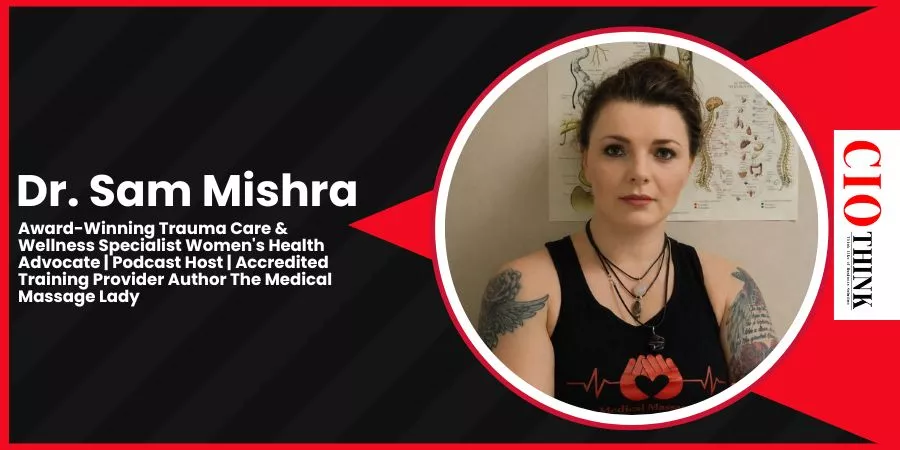
Surgical nurse. Midwife. Trauma practitioner. Abuse survivor. Mother of a child with cerebral palsy. Author. Podcast host. International award winner across four continents. The biography of Dr. Sam Mishra reads less like a career path and more like a testament, to what a woman can build from the wreckage of everything she was never supposed to survive.
Through The Medical Massage Lady, Dr. Mishra has created something the wellness industry rarely offers: a space where clinical expertise meets radical compassion, where survivors are not managed but genuinely witnessed, and where healing reaches the places words alone cannot touch. Her work, spanning massage therapy, breathwork, trauma-informed bodywork, hypnotherapy, and spiritual coaching, is not a collection of modalities. It is a philosophy. And at its centre sits one unwavering conviction: nobody should have to heal alone.
THE JOURNEY BEHIND THE MISSION
Your journey spans surgical nursing, midwifery, trauma care, and transformational wellness. What inspired your path into women’s health and holistic healing, and what experiences shaped your mission?
My path into women’s health was never a straight line, it was shaped by necessity, loss, and a deep personal understanding of what it means to be failed by the systems meant to protect you.
Nursing led me to midwifery, where witnessing the raw vulnerability of birth ignited something profound in me, but it was my own life, surviving an abusive marriage, raising a child with cerebral palsy, navigating chronic pain and complex grief, that revealed the limits of conventional care and the desperate need for something more human.
When I returned to massage after years away, I remembered how it had helped my daughter’s cerebral palsy. That memory became a bridge between my medical background and a more holistic approach to healing. I had also lived through trauma that talk therapy alone couldn’t reach, and I knew others had too.
Every specialism I’ve pursued, oncology massage, breathwork, trauma-informed bodywork, hypnotherapy, emerged from asking what my clients actually needed, not what the industry was comfortable offering. Women especially came to me carrying wounds that had never been properly witnessed.
My mission is simply this: to offer the support I desperately needed and never received, and to ensure no one heals entirely alone.
Having worked in high-risk labour suites and childhood disability care, you have witnessed human resilience in its rawest form. How have these experiences influenced your perspective on healing and wellness?
Working in labour suites, I witnessed women summoning strength they never knew they possessed, in pain, in fear, and in the most vulnerable moments of their lives. That rawness stays with you. It teaches you that the human body and spirit are capable of extraordinary things, even when everything feels impossible.
Caring for my daughter after her cerebral palsy diagnosis deepened that understanding entirely. Watching her navigate a world not built for her, and seeing how therapeutic touch eased her spasticity and brought her comfort, showed me that healing doesn’t always begin with words. Sometimes it begins with presence.
These experiences fundamentally shaped how I approach wellness. I stopped seeing the body and mind as separate concerns to be treated in isolation. Real healing requires witnessing the whole person, their history, their nervous system, their unspoken pain. It requires patience, not protocols.
I also learned that resilience is rarely loud or triumphant. Most often it’s quiet, exhausted, and still showing up. That understanding made me a more compassionate practitioner and a better human being.
When clients arrive feeling broken, I recognise something of myself and the women I supported through birth and disability, people who were far stronger than they believed, even in their darkest moments.
Your story also includes personal experiences with domestic abuse, which you now transform into advocacy and support for others. How has your personal journey shaped the compassionate approach you bring to your work today?
Surviving domestic abuse gives you an education no training course can replicate. You understand the paralysis of feeling trapped, the shame of hiding what’s happening behind closed doors, and the devastating confusion of not immediately recognising what’s being done to you as abuse. That knowledge lives in my body, not just my memory.
For over nine years I endured every form of abuse imaginable, protecting my children while simultaneously trying to make sense of my own reality. When I eventually built my practice, I carried every one of those years with me, not as wounds, but as windows into what survivors genuinely need.
Compassion, in my work, isn’t a professional technique. It’s the natural consequence of having been there. When a client cannot find the words, I understand that silence. When someone minimises their experience, I recognise that instinct. When they feel undeserving of care, I remember feeling exactly the same.
That personal history also fuels my advocacy. Having navigated trauma with virtually no support, I felt a profound responsibility to ensure others wouldn’t face the same isolation. My charity referral programme, my trauma-informed approach, my willingness to speak openly about abuse, all of it stems from one simple conviction: nobody should have to heal alone.
REDEFINING WELLNESS & TRAUMA CARE
As a trauma practitioner and transformation coach, what are some of the most overlooked emotional or psychological struggles women silently carry?
Among the most overlooked struggles are the ones women never speak aloud. The shame that follows sexual or domestic abuse doesn’t announce itself, it quietly rewires a woman’s relationship with her own body, her boundaries, and her sense of deserving love.
Many women carry the belief that what happened to them was them, that the abuse defined their worth. This manifests as chronic people-pleasing, difficulty saying no, and an almost invisible grief for the self they were before.
The transition through motherhood is equally silent. Women lose themselves in caregiving, then face a devastating disorientation when they try to reclaim womanhood, not knowing who they are outside of that role, feeling invisible both physically and emotionally.
Body image after trauma is profoundly misunderstood. Women don’t just dislike their reflection, they become strangers to their own bodies. Touch feels threatening. Intimacy feels unsafe. Orgasm feels unreachable, not because of physical inability, but because genuine pleasure requires a felt sense of safety that trauma systematically destroys.
Underneath it all sits the deepest wound, the belief, often planted in childhood, that they were never quite enough to be loved without conditions.
You are deeply involved in trauma-informed care and creating safe spaces for survivors of abuse and assault. Why is emotional safety such a critical part of the healing process?
Emotional safety isn’t simply a comfort, it is the biological precondition for healing. Trauma doesn’t live in memory alone; it lives in the nervous system, in muscles that brace without warning, in a body perpetually scanning for threat. Without genuine emotional safety, that system never downregulates enough to allow real healing to begin.
For survivors of abuse and assault, trust has been systematically dismantled, often by the very people who should have been safest. Healing therefore cannot happen in spaces that replicate that powerlessness, however subtly. The practitioner’s tone, their boundaries, their consistency, these are not peripheral details, they are therapeutic tools.
What I have witnessed repeatedly is that when a survivor finally feels truly safe, not managed, not handled, but genuinely held without judgement, something extraordinary happens. The body begins to exhale. The nervous system shifts from survival mode into something softer, and that is where transformation becomes possible.
Emotional safety also restores agency. Abuse strips choice away. Every moment within a safe therapeutic space quietly returns it. When a woman learns she controls what happens to her body again, even in something as simple as a treatment session, that is not a small thing — that is everything.
Your work integrates massage therapy, breathwork, energy healing, hypnotherapy, and spiritual coaching. How do these modalities work together to support lasting transformation?
Trauma is not a single-layer wound, and therefore it cannot be addressed by a single-layer approach. Each modality reaches a different depth of the human experience, and together they create something far more powerful than any one could achieve alone.
Massage works where words cannot reach, directly into the tissue where trauma is stored, gently coaxing the nervous system out of chronic survival responses. Breathwork accesses the subconscious, bypassing the analytical mind to release what has been buried far beneath conscious awareness. Together they regulate the nervous system, creating the physiological foundation everything else requires.
Hypnotherapy then works within that calmer state, reaching the deeply embedded beliefs formed during abuse or childhood, the stories we were given about our unworthiness, our culpability, our smallness. Energy healing and reiki address the parts of trauma that exist beyond the purely physical or psychological, the energetic imprints that can persist long after cognitive understanding has been achieved.
Spiritual coaching holds the entire process, helping survivors find meaning, reconnect with identity, and rebuild a relationship with themselves that feels purposeful rather than merely functional.
None of these modalities competes. Each one opens a door the others cannot, and lasting transformation walks through all of them.
LEADERSHIP, ADVOCACY & EMPOWERMENT
As a women’s health advocate and accredited training provider, how do you empower other practitioners to approach healing with both skill and empathy?
Drawing from both clinical expertise and lived experience, I empower practitioners to understand that technical skill alone is insufficient. True therapeutic care requires the integration of medical knowledge with genuine human connection.
Through my training programmes, I emphasise that practitioners must develop an understanding of how trauma lives in the body, not merely textbook theory. When therapists grasp why a survivor flinches at touch, or why the nervous system responds as it does, their approach transforms entirely.
I also model vulnerability as a professional strength. By openly sharing my own journey through abuse, chronic pain, and PTSD, I demonstrate that authenticity builds the trust necessary for genuine healing. Clients who feel seen rather than assessed are far more likely to experience meaningful recovery.
My courses deliberately challenge the low standards prevalent in the massage industry, equipping practitioners with specialised knowledge in trauma, oncology, and disability care, areas mainstream training routinely neglects.
Perhaps most importantly, I teach therapists that their role carries profound responsibility. Practical skills allow someone to perform massage, but knowledge holds the power to transform both practitioner and client. Compassion without competence is insufficient, and competence without compassion is incomplete. Genuine healing demands both, working in concert.
You have been recognised internationally through awards, publications, and your contributions to Brainz Magazine. What does this recognition mean to you personally and professionally?
International recognition was never something I sought or anticipated. Growing up without affirmation, shaped by a narcissistic mother who dismissed my opinions and predicted my failure, the idea that my work would be acknowledged across four continents would have seemed incomprehensible to my younger self.
Personally, these recognitions represent something far deeper than professional validation. They symbolise the distance travelled from a sofa where I sat for years in grief and suicidal darkness, to becoming someone whose work genuinely impacts lives globally. Every award is quietly dedicated to the version of me who nearly did not survive.
Professionally, the visibility has been transformative. My executive contributor role with Brainz Magazine evolved organically from writing about massage into exploring trauma and mental health, reflecting exactly how my practice itself has grown. That platform gave me permission to challenge stigmas publicly and reach people who needed that conversation, which I am also now doing through my new book, Where Wounds Live.
However, I hold recognition lightly. Seven global awards matter far less to me than the message a client sends describing their first night of peaceful sleep after years of trauma, or a therapist reporting that my training changed how they hold space for survivors.
Recognition opens doors. What matters is what you build once you walk through them.
Through your workshops, retreats, and podcast, you continue to inspire and educate others globally. What message do you most hope women take away from your work?
The message I most hope women carry from my work is beautifully simple yet profoundly challenging to internalise: your trauma does not define your worth, and your pain can become your greatest source of purpose.
Too many women arrive in my spaces having been systematically diminished, by absent parents, abusive partners, or a society that consistently undervalues their experiences. They have learned to shrink themselves, to apologise for their emotions, and to mistake survival for weakness.
I want them to understand that every difficult emotion carries a message rather than representing a flaw. That the sensitivity they have been punished for is actually their superpower. That healing does not mean reverting to who you were before the pain, it means becoming who you were always meant to be.
Through my podcast, workshops, and writing, I consistently model that vulnerability and strength are not opposites. They are partners.
If a woman leaves my work standing slightly straighter, trusting herself marginally more, and recognising that her story matters, then everything I have endured and everything I continue to build has been entirely worthwhile.
VISION, LEGACY & THE FUTURE OF WELLNESS
Looking ahead, how do you envision the future of women’s wellness and trauma-informed healing evolving over the next decade?
The future I envision is one where trauma-informed care becomes the standard rather than the exception, where practitioners across every healing discipline understand that the body holds the story that words sometimes cannot tell.
Over the next decade, I believe we will witness a profound shift away from compartmentalised healthcare towards genuinely integrated approaches that honour the connection between nervous system regulation, emotional processing, and physical wellbeing. The conversation is already changing, and I intend to remain at its forefront.
Women’s wellness specifically must evolve beyond aesthetics and surface-level self-care into something with genuine clinical and emotional depth. Conditions like endometriosis, birth trauma, and the somatic effects of domestic abuse deserve the same rigorous attention as any mainstream medical concern.
I also believe community-based healing will grow in significance. Isolation compounds trauma, and collective healing spaces offer something clinical environments rarely can.
Most critically, financial barriers must be dismantled. Healing cannot remain a privilege reserved for those who can afford it. My charity referral programme represents one small answer to that challenge, but systemic change requires the entire industry to rethink accessibility, urgently and unapologetically.
What legacy do you hope to leave behind for future generations of women and healers?
The legacy I hope to leave is captured within the very title of my book, Where Wounds Live. Because that is precisely where healing must begin, not in the polished narratives we present to the world, but in the raw, unexamined places we have been taught to hide.
For future generations of women, I hope to leave proof that surviving the unsurvivable is possible, and that what emerges from that survival can be extraordinary. That shame has no permanent address, and that wounds, when properly witnessed, become wisdom.
For future healers, I hope Where Wounds Live becomes both a resource and a permission slip, permission to bring their whole selves into their practice, to challenge inadequate industry standards, and to treat every client as someone deserving of genuinely transformative care.
My deepest hope is that every therapist I train, every survivor I support, and every reader my book reaches, goes on to create their own ripple of healing.
Legacy is never truly about one person. It is about how many others rise because you refused to stay down.
Also Read: An Iconic Women’s Health Advocate Shaping the Future of Wellness, 2026