

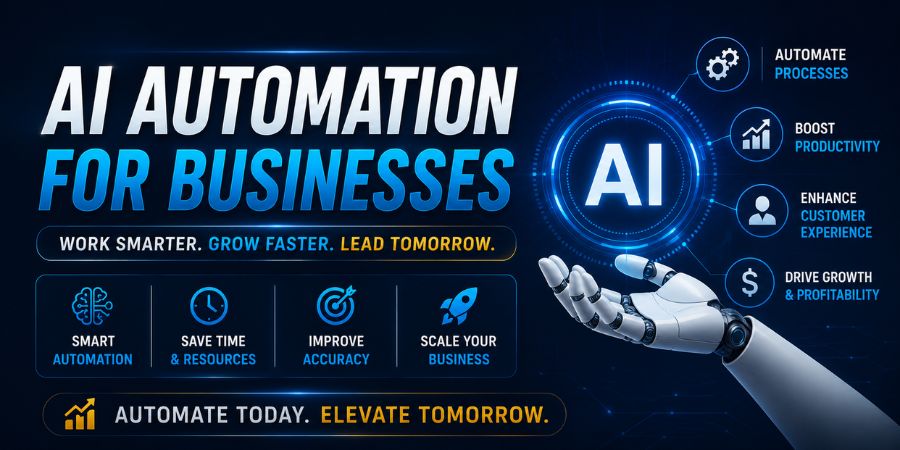
A small business owner who once spent entire evenings replying to emails, updating spreadsheets, scheduling appointments, and chasing customer follow-ups can now automate most of those repetitive tasks in a single afternoon. That shift is exactly why ai automation for businesses has become one of the biggest competitive advantages in 2026. Companies no longer need massive teams or huge budgets to operate efficiently. From startups and online businesses to local service providers and ecommerce brands, AI automation is helping businesses save time, reduce operational costs, improve customer experience, and scale faster than ever before. The businesses growing the fastest today are not necessarily the ones working the hardest—they are the ones building smarter systems that allow automation to handle repetitive work while humans focus on strategy, creativity, and customer relationships.
What Is AI Automation for Businesses?
AI automation for businesses refers to using artificial intelligence tools and software to automate tasks, workflows, decisions, and customer interactions that previously required manual human effort.
Traditional automation follows fixed rules. AI automation goes a step further because it can:
- Learn from data
- Improve over time
- Understand patterns
- Handle language and conversations
- Make recommendations
- Predict outcomes
- Personalize customer experiences
This technology is now accessible to startups, home-based business owners, freelancers, ecommerce sellers, agencies, and enterprise companies alike.
Instead of hiring large teams for repetitive operational tasks, businesses can use AI-powered systems to automate:
- Customer support
- Email marketing
- Lead generation
- Appointment scheduling
- Inventory management
- Social media posting
- Accounting workflows
- Data analysis
- Recruitment screening
- Sales follow-ups
- Content generation
The biggest advantage is not just cost reduction. It is scalability. A business that automates effectively can handle more customers, faster growth, and higher operational complexity without proportionally increasing expenses.
Why AI Automation Is Becoming Essential in 2026
Businesses today operate in a highly competitive environment where speed matters more than ever.
Customers expect:
- Instant responses
- Personalized experiences
- Fast delivery
- 24/7 support
- Seamless communication
At the same time, business owners face rising operational costs, employee burnout, and increasing competition from online businesses and global brands.
AI automation solves several of these problems simultaneously.
The Shift From Manual Operations to Intelligent Systems
In the past, automation was expensive and limited to large corporations. Today, affordable AI tools allow even small businesses to automate sophisticated workflows.
For example:
A solo entrepreneur can now:
- Use AI chatbots for customer service
- Automate invoices and bookkeeping
- Generate marketing content
- Schedule meetings automatically
- Analyze customer behavior
- Run targeted email campaigns
This dramatically increases productivity without needing a large team.
Major Benefits of AI Automation for Businesses
1. Reduced Operational Costs
Hiring employees for repetitive tasks is expensive. AI systems can automate many routine processes at a fraction of the long-term cost.
Examples include:
- Automated customer support
- AI data entry
- Invoice processing
- Email handling
- Appointment scheduling
Businesses can reduce overhead while maintaining efficiency.
2. Faster Decision-Making
AI tools analyze large amounts of data quickly.
Instead of manually reviewing reports, businesses can use AI dashboards to identify:
- Sales trends
- Customer behavior
- Inventory patterns
- Marketing performance
- Financial insights
This allows business owners to make informed decisions faster.
3. Improved Customer Experience
Modern consumers expect immediate service.
AI-powered chatbots and customer service systems can:
- Answer common questions instantly
- Resolve support issues
- Recommend products
- Personalize communication
- Operate 24/7
Customers receive faster responses while businesses improve satisfaction levels.
4. Increased Productivity
Employees spend enormous amounts of time on repetitive administrative work.
AI automation frees teams to focus on:
- Strategy
- Creativity
- Innovation
- Relationship building
- Business development
This creates better overall performance.
5. Better Marketing Performance
AI-driven marketing tools help businesses optimize campaigns by analyzing customer behavior and engagement data.
Businesses can automate:
- Email campaigns
- Social media scheduling
- Ad targeting
- Customer segmentation
- Product recommendations
This leads to higher conversions and improved ROI.
How AI Automation Works in Real Businesses
AI automation is not just for tech companies. Almost every industry can benefit from it.
Retail and Ecommerce
Online stores use AI to:
- Recommend products
- Automate abandoned cart emails
- Predict inventory demand
- Handle customer support
- Optimize pricing
Example:
An ecommerce brand selling skincare products can use AI to recommend personalized skincare routines based on customer quizzes and purchasing history.
Service Businesses
Local service providers automate:
- Appointment booking
- Client reminders
- Follow-up messages
- Payment collection
- Customer reviews
A salon owner can automate appointment confirmations, reducing missed bookings significantly.
Digital Marketing Agencies
Agencies use AI for:
- Content generation
- SEO analysis
- Reporting
- Social media scheduling
- Ad optimization
This allows smaller agencies to handle more clients efficiently.
Healthcare Businesses
Healthcare providers automate:
- Patient scheduling
- Documentation
- Appointment reminders
- Insurance processing
- Data analysis
This reduces administrative burden on staff.
Real Estate Businesses
Real estate professionals use AI for:
- Lead nurturing
- Property recommendations
- Automated email follow-ups
- Market analysis
- Customer communication
AI helps agents respond faster and close deals more efficiently.
Step-by-Step Guide to Implementing AI Automation in a Business
Many businesses fail with automation because they try to automate everything at once.
The smarter approach is gradual implementation.
Step 1: Identify Repetitive Tasks
Start by identifying tasks that:
- Consume time daily
- Follow repetitive patterns
- Require minimal creative thinking
- Create operational bottlenecks
Examples:
- Responding to FAQs
- Scheduling appointments
- Sending invoices
- Updating spreadsheets
- Posting on social media
These are ideal starting points.
Step 2: Prioritize High-Impact Areas
Not all automation produces equal results.
Focus first on areas that:
- Save significant time
- Improve customer experience
- Increase revenue
- Reduce errors
For many businesses, customer support and lead management provide the quickest returns.
Step 3: Choose the Right AI Tools
Businesses should avoid selecting tools based purely on popularity.
Instead, evaluate:
- Ease of use
- Integration capability
- Scalability
- Pricing
- Customer support
- Industry relevance
Simple tools often outperform overly complex systems for smaller businesses.
Step 4: Start Small
Avoid over-automation initially.
Begin with one workflow.
Example:
Automate:
- Customer inquiry responses
- Email follow-ups
- Appointment scheduling
Measure results before expanding.
Step 5: Train Employees
AI automation works best when employees understand how to collaborate with automated systems.
Businesses should train teams to:
- Monitor AI outputs
- Handle exceptions
- Improve workflows
- Analyze automation reports
Human oversight remains essential.
Step 6: Continuously Optimize
Automation is not a one-time setup.
Businesses should regularly review:
- Customer feedback
- Workflow performance
- Conversion rates
- Response times
- Error rates
Continuous improvement creates long-term efficiency.
Best AI Automation Areas for Small Businesses in 2026
Small businesses often assume AI automation is expensive or overly technical. In reality, many affordable tools now offer enterprise-level functionality.
Customer Support Automation
AI chatbots can:
- Answer FAQs
- Handle common support requests
- Provide order updates
- Route customers correctly
This reduces workload while improving response speed.
Practical Example
A home-based online business selling handmade products may receive hundreds of repetitive questions about shipping times and returns.
An AI chatbot can instantly answer those questions without requiring manual responses.
Email Marketing Automation
AI-powered email systems can:
- Personalize campaigns
- Segment customers
- Predict engagement
- Optimize send times
- Write subject lines
Businesses can improve email performance while saving hours each week.
Social Media Automation
AI tools now help businesses:
- Generate captions
- Schedule posts
- Analyze engagement
- Suggest content ideas
- Repurpose content
This is especially valuable for small business owners managing multiple platforms.
Sales Funnel Automation
Businesses can automate:
- Lead capture
- Follow-up emails
- Appointment booking
- CRM updates
- Proposal generation
This improves lead conversion rates dramatically.
Accounting and Finance Automation
AI accounting systems can:
- Track expenses
- Generate invoices
- Reconcile transactions
- Forecast cash flow
- Detect unusual spending patterns
This reduces administrative complexity.
Low Investment AI Automation Business Ideas
The rise of AI has also created entirely new business opportunities.
Entrepreneurs can launch profitable ventures with relatively low investment.
AI Automation Consulting
Many businesses know they need automation but do not know where to start.
An AI automation consultant helps companies:
- Identify inefficiencies
- Recommend tools
- Build workflows
- Implement systems
This business can start with minimal overhead.
AI Content Services
Businesses constantly need:
- Blog content
- Email copy
- Product descriptions
- Social media captions
- SEO content
AI-assisted content businesses can scale efficiently while maintaining human editing quality.
Chatbot Setup Services
Many small businesses want customer support automation but lack technical expertise.
Entrepreneurs can offer:
- Chatbot setup
- Conversation design
- Integration services
- Workflow optimization
This is becoming a highly profitable niche.
AI Marketing Agency
Modern agencies increasingly use AI for:
- Ad optimization
- Analytics
- Copywriting
- Customer segmentation
- Reporting
This creates scalable online business opportunities.
AI-Powered Virtual Assistant Services
Virtual assistants can now combine human support with AI systems to provide faster services.
Tasks may include:
- Inbox management
- Scheduling
- Research
- CRM updates
- Customer support
This hybrid approach is highly efficient.
Common Mistakes Businesses Make With AI Automation
Despite its advantages, many businesses struggle with implementation.
Automating Broken Processes
Automation cannot fix poorly designed workflows.
If a process is inefficient manually, automating it may simply accelerate inefficiency.
Businesses should optimize workflows first.
Over-Automating Customer Interactions
Customers still value human connection.
Businesses that rely entirely on AI without human support often create frustrating experiences.
The best approach combines automation with accessible human assistance.
Choosing Too Many Tools
Many startups overload themselves with disconnected software platforms.
This creates:
- Complexity
- Integration problems
- Higher costs
- Team confusion
A streamlined technology stack is usually more effective.
Ignoring Data Privacy
AI systems often process customer data.
Businesses must prioritize:
- Security
- Compliance
- Data protection
- Transparency
Failure to do so can damage customer trust.
Expecting Instant Results
AI automation is a long-term operational strategy.
Results improve over time through:
- Optimization
- Workflow refinement
- Better data
- Employee adaptation
Patience and consistency matter.
How AI Automation Changes Entrepreneurship
AI automation is fundamentally reshaping entrepreneurship.
Previously, scaling a business required:
- Large teams
- Significant capital
- Extensive infrastructure
Today, small teams can operate at levels previously impossible.
A single entrepreneur can:
- Build an online business
- Automate marketing
- Manage customer support
- Create content
- Analyze data
- Handle sales funnels
This dramatically lowers barriers to entry.
AI Automation and the Future of Work
One major concern surrounding AI automation is job displacement.
However, the broader reality is more nuanced.
AI primarily replaces repetitive, predictable tasks while increasing demand for:
- Strategic thinking
- Creativity
- Leadership
- Relationship management
- Problem-solving
Businesses that adapt successfully use AI to enhance human productivity rather than eliminate human involvement entirely.
Practical Examples of AI Automation for Businesses
Example 1: Local Fitness Studio
A small fitness studio automates:
- Membership renewals
- Class reminders
- Customer onboarding emails
- Feedback requests
Result:
- Reduced missed appointments
- Higher retention rates
- Less administrative work
Example 2: Ecommerce Store
An online clothing store uses AI for:
- Product recommendations
- Customer service chatbots
- Inventory forecasting
- Personalized email marketing
Result:
- Increased sales
- Better customer experience
- Improved operational efficiency
Example 3: Freelance Marketing Consultant
A freelance consultant automates:
- Proposal generation
- Client onboarding
- Meeting scheduling
- Invoice reminders
Result:
- More client capacity
- Faster turnaround
- Higher productivity
Example 4: Real Estate Agency
A real estate business automates:
- Lead nurturing
- Property alerts
- Follow-up sequences
- Appointment booking
Result:
- Faster lead response
- Improved conversion rates
- Reduced manual workload
Best Practices for Successful AI Automation
Focus on Outcomes, Not Technology
Businesses should prioritize business problems first.
The goal is not simply to use AI. The goal is to:
- Improve efficiency
- Increase profitability
- Enhance customer experience
- Support growth
Technology is only a tool.
Maintain Human Oversight
AI systems still require monitoring.
Businesses should review:
- Automated communications
- AI-generated content
- Customer interactions
- Decision accuracy
Human judgment remains essential.
Build Scalable Systems
Businesses should think long term.
Choose systems capable of growing with operational complexity.
This prevents costly migrations later.
Prioritize Customer Experience
Automation should make customer experiences smoother, not colder or more frustrating.
The best automation feels:
- Helpful
- Fast
- Personalized
- Seamless
Customers should never feel trapped inside a robotic system.
Industries That Will See Massive AI Automation Growth
Several sectors are expected to experience particularly rapid AI adoption in 2026 and beyond.
Ecommerce
AI-driven personalization and logistics optimization are transforming online retail.
Healthcare
Administrative automation and predictive analytics are improving operational efficiency.
Finance
AI fraud detection and automated analysis continue expanding rapidly.
Education
AI-powered learning systems and tutoring platforms are growing significantly.
Logistics
Supply chain optimization and predictive systems are becoming increasingly important.
Marketing
AI-generated content and customer analysis tools are now mainstream.
The Financial Impact of AI Automation
Businesses often underestimate the financial implications of automation.
The value extends beyond direct cost reduction.
Revenue Growth Opportunities
AI helps businesses:
- Respond faster to leads
- Improve customer retention
- Increase conversion rates
- Personalize recommendations
- Upsell more effectively
These improvements directly impact revenue.
Operational Efficiency
Automation reduces:
- Manual errors
- Delays
- Administrative bottlenecks
- Employee burnout
This creates healthier business operations overall.
How Startups Can Compete Using AI Automation
Startups now have unprecedented leverage.
A lean startup with effective automation can compete against much larger companies.
Key advantages include:
- Faster adaptation
- Lower operating costs
- Greater flexibility
- Rapid experimentation
- Scalable systems
AI automation levels the playing field significantly.
AI Automation Tools Businesses Commonly Use
Businesses today combine multiple tools depending on operational needs.
Popular categories include:
Communication Automation
- AI chatbots
- Automated email assistants
- Customer support systems
Marketing Automation
- Email platforms
- Social media schedulers
- SEO optimization tools
Workflow Automation
- Task automation systems
- CRM automation
- Project management integrations
Analytics Automation
- AI dashboards
- Predictive analytics
- Reporting systems
The best technology stack depends on business size, industry, and goals.
The Ethical Side of AI Automation
Businesses adopting AI must consider ethical implications.
Important concerns include:
- Data privacy
- Bias in algorithms
- Transparency
- Customer trust
- Responsible communication
Trust becomes increasingly valuable in an AI-driven marketplace.
Businesses that prioritize ethical automation are likely to build stronger long-term reputations.
How to Measure AI Automation Success
Many businesses implement automation without measuring effectiveness.
Key performance indicators include:
- Time saved
- Cost reduction
- Customer satisfaction
- Lead conversion rates
- Employee productivity
- Revenue growth
- Error reduction
Tracking these metrics helps businesses optimize strategies over time.
Frequently Asked Questions
What is AI automation for businesses?
AI automation for businesses involves using artificial intelligence tools to automate repetitive tasks, workflows, customer interactions, and operational processes to improve efficiency and scalability.
Is AI automation expensive for small businesses?
Not necessarily. Many AI tools now offer affordable pricing models suitable for startups, freelancers, and home-based business owners. Businesses can begin with low-cost automation solutions and scale gradually.
Which business processes should be automated first?
Businesses should usually automate repetitive, time-consuming tasks first, such as customer support, scheduling, invoicing, lead follow-ups, and email marketing.
Can AI automation replace employees completely?
AI automation typically works best alongside human employees. It handles repetitive tasks while humans focus on creativity, decision-making, strategy, and relationship management.
How long does it take to see results from AI automation?
Some businesses see productivity improvements within weeks. However, long-term operational and financial benefits usually develop through continuous optimization over several months.
Final Thoughts
The businesses growing fastest in 2026 are not necessarily the ones with the biggest budgets or largest teams. They are the businesses building intelligent systems that remove friction, improve efficiency, and allow people to focus on higher-value work. AI automation for businesses is no longer a futuristic concept reserved for major corporations. It is now an accessible operational advantage for startups, freelancers, local businesses, ecommerce brands, and entrepreneurs across nearly every industry. The companies that succeed over the next decade will likely be those that learn how to combine human creativity with smart automation in ways that genuinely improve customer experiences and business performance.
Also Read: Industrial Entrepreneurs Memorandum in 2026: Everything Businesses Must Know