
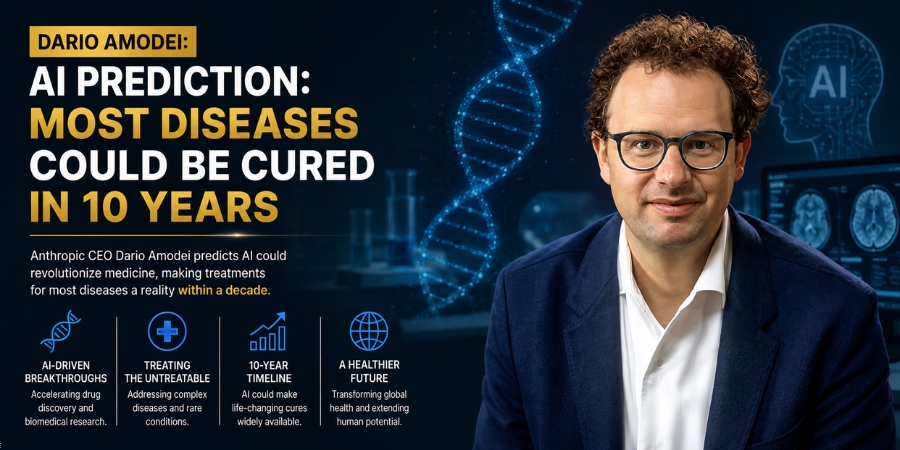
The Dario Amodei AI prediction that artificial intelligence could help cure most human diseases within five to 10 years is putting the spotlight on AI’s potential role in medical research. Anthropic CEO Dario Amodei has argued that major advances in artificial intelligence could accelerate the search for treatments, while former OpenAI executive Fidji Simo has stressed that better biological data will be essential to turning that potential into real medical breakthroughs.
Amodei’s forecast, reported on August 19, 2026, is ambitious even by the standards of the rapidly developing AI industry. He has framed medical breakthroughs as one of the clearest ways AI could demonstrate tangible value, rather than relying only on increasingly capable models or promises about future benefits.
Dario Amodei AI forecast puts medicine at the centre of debate
The Dario Amodei AI forecast focuses on the possibility that increasingly capable systems could speed up biological research and contribute to breakthroughs against serious diseases.
Amodei’s prediction covers a five-to-10-year timeframe for most human diseases. However, the forecast is not an established scientific timetable. Medical discoveries still have to move from research and potential drug targets through laboratory testing, clinical trials and regulatory review before treatments can reach patients.
The distinction matters because AI can accelerate parts of the discovery process without eliminating the biological and clinical work required to establish whether a treatment is safe and effective.
Why biological data may determine AI’s medical impact
Fidji Simo, former senior OpenAI executive and co-founder of biomedical startup ChronicleBio, has offered a related but more data-focused perspective.
According to Moneycontrol’s report, Simo said she shares Amodei’s belief that genuine medical achievements would be a meaningful test of AI’s value, despite disagreeing with him on many other issues. She argued that progress will require not only more capable AI models but also the biological information needed to study diseases effectively.
That creates an important limitation for the Dario Amodei AI vision. AI systems depend on the quality and depth of information available to them, and medical research does not have equally extensive datasets for every disease.
Cancer, for example, may have an advantage because decades of research have generated substantial biological and clinical information. More complex chronic conditions may face greater challenges where underlying data and research infrastructure are less developed.
AI drug discovery still faces major clinical hurdles
AI is already being used in areas such as identifying potential drug targets, examining molecular interactions and accelerating parts of drug discovery. But identifying a promising candidate does not establish that it can become a successful medicine.
The development process still requires laboratory research, human clinical trials and regulatory approval. The US Food and Drug Administration and European Medicines Agency require AI-supported drug-development tools to meet appropriate standards for reliability, safety and effectiveness.
For that reason, the Dario Amodei AI prediction should be understood as a forward-looking assessment rather than evidence that most diseases are already close to being cured.
What Amodei’s prediction could mean for AI and healthcare
The debate reflects a broader question about how the public should judge artificial intelligence in medicine. Faster models and stronger computational capabilities may be valuable, but their ultimate impact will depend on whether they contribute to measurable advances in healthcare. This shift also connects with broader healthcare industry trends in 2026, where AI, personalized care, and data-driven systems are reshaping the future of medicine.
Anthropic’s own survey found that curing diseases such as cancer or Alzheimer’s ranked among Americans’ major hopes for AI. That makes medical progress particularly significant to the industry’s effort to demonstrate practical benefits from artificial intelligence.
The Dario Amodei AI forecast therefore goes beyond a prediction about technology. It highlights a potential shift in how AI’s success could be measured: not simply by model performance, but by whether those systems help researchers develop treatments capable of improving and saving lives.
For now, the five-to-10-year timeframe remains Amodei’s ambitious prediction. Whether AI can approach that vision will depend on advances in biological data, research methods, experimental validation and clinical development.
The Dario Amodei AI debate ultimately underscores both sides of AI-powered medicine: increasingly capable systems may accelerate discovery, but scientific evidence and clinical testing remain indispensable.
This news has been compiled using information gathered from various platforms and is intended for general informational purposes only.