
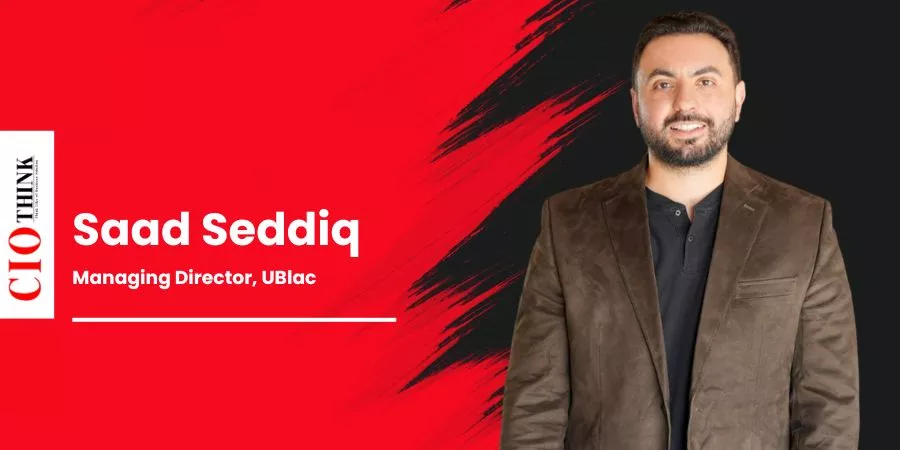
Across the Arab region, the creative economy is undergoing a period of structural change. As markets mature and expectations rise, leadership is increasingly defined less by visibility and more by standards, systems, and delivery. Within this shift, Saad Seddiq, Managing Director of UBlac, represents a leadership approach grounded in clarity, accountability, and execution.
Seddiq’s work sits at the intersection of branding, design, and operational discipline. Rather than focusing on novelty or short-term recognition, his leadership has been shaped by sustained client pressure, complex decision-making, and the challenge of building consistency in an environment where trust must be earned repeatedly.
His approach reflects a broader transition in the region, from consuming global benchmarks to producing work that can compete internationally on quality and reliability.
Vision, Design, Execution: A Practical Leadership Framework
Seddiq’s leadership philosophy is summarized in three principles: Vision, Design, and Execution. These are not abstract values, but operational filters used to guide decisions at every level of the business.
Vision defines priorities and boundaries before creative work begins. It clarifies what matters, what does not, and what standards will not be compromised. Without this clarity, Seddiq believes creative output loses direction and teams lose alignment.
Design translates vision into structure. This includes brand architecture, positioning, systems, and experiences that can be recognized and applied consistently. Design, in this context, is not decoration but organization and intent.
Execution is where the framework is tested. In Seddiq’s experience, execution determines whether ideas survive real-world constraints such as timelines, budgets, and operational complexity. Consistency, timing, and quality are treated as core brand assets rather than secondary considerations.
This framework developed through experience rather than theory, shaped by repeated exposure to client accountability and the practical demands of delivery.
From Cromapix to UBlac: An Evolution in Identity
UBlac emerged as an evolution of Cromapix, the agency’s original identity. Cromapix established the foundation, including client relationships, operational knowledge, and credibility built over several years.
As the scope and ambition of the work expanded, the existing identity no longer reflected the direction of the company. The decision to rebrand was therefore strategic rather than cosmetic.
The name UBlac is derived from the Old English word blāc, meaning bright or shining. Internally, it became a guiding idea: brands should stand out through clarity, differentiation, and consistent execution. Over time, this principle extended beyond brand work to influence how teams, systems, and leadership practices were designed.
The transition was managed carefully to preserve existing trust. Standards were maintained, processes refined, and the client experience strengthened. Rather than signaling a break from the past, the rebrand represented continuity with sharper focus.
Client and Agency Perspective
Seddiq’s experience on both the client and agency sides informs his leadership style. On the client side, he encountered board-level accountability, budget constraints, and long-term brand risk. On the agency side, he learned how difficult it is to make quality repeatable across teams and timelines.
This dual perspective shaped a practical approach. Speed is valued, but not at the expense of clarity. Budgets are respected, but not allowed to undermine strategic thinking. Creativity is encouraged, but always anchored in business context.
The objective is to build teams that give clients confidence: confidence that the agency understands the business, the audience, and the implications of each decision.
Values in Practice
Three values consistently guide Seddiq’s leadership: integrity, taste, and accountability.
Integrity refers to follow-through and transparency, especially under pressure. Taste functions as a quality filter, protecting brand perception through attention to detail and coherence. Accountability is treated as a leadership responsibility rather than something delegated.
These values are embedded in process rather than stated as principles. When issues arise, responsibility is addressed first, followed by system-level adjustments to prevent recurrence.
Creativity Supported by Structure
UBlac operates with the assumption that creative excellence and commercial discipline must coexist. Each project begins with a clear definition of the business problem and measurable outcomes.
Creative teams are given flexibility within defined strategic frameworks, including positioning, tone, and narrative direction. Execution is supported through structured scoping, timeline management, and decision protocols.
To support this discipline, UBlac developed an internal CRM system in which every project is broken down into tasks, and each task is time logged. This allows the agency to monitor delivery efficiency, identify bottlenecks, and scale operations without relying on individual heroics.
Trust as an Operating Principle
As Managing Director, Seddiq remains closely involved in client relationships. Trust, in his view, is built through consistency rather than promises. Responsiveness, clarity, professionalism, and delivery standards are treated as daily practices.
Clients are viewed as long-term partners rather than short-term engagements. This includes protecting long-term brand positioning and communicating openly when trade-offs or risks exist.
Regional Identity and Global Direction
Seddiq sees the Arab creative sector entering a more confident phase, one in which regional brands are beginning to export ideas, products, and cultural narratives rather than replicate external models.
UBlac reflects this approach through execution standards rather than rhetoric. The agency integrates creativity with technology and operational rigor to support scale and consistency.
The opening of UBlac’s Sydney office represents a practical step in this direction. Rather than positioning geography as a limitation, the expansion reflects a belief that quality and process can travel.
Leadership, Talent, and Sustainability
Within UBlac, talent development is centered on responsibility and feedback. Performance expectations are clear, coaching is direct, and excellence is recognized through measurable contribution rather than individual visibility.
The aim is to build professionals capable of consistent delivery rather than isolated creative peaks. As systems strengthen, individuals develop alongside them.
Looking Toward 2026
For Seddiq, success is defined by relevance and longevity rather than rapid growth alone. His focus is on building a company that can operate independently of individual presence, sustained by clear philosophy, repeatable systems, and shared standards.
UBlac is positioned as a platform rather than a personality-driven agency, designed to support brands, teams, and long-term value creation.
As the Arab creative economy continues to evolve, Saad Seddiq’s work offers a case study in disciplined leadership, where execution is treated not as an outcome, but as a system.