
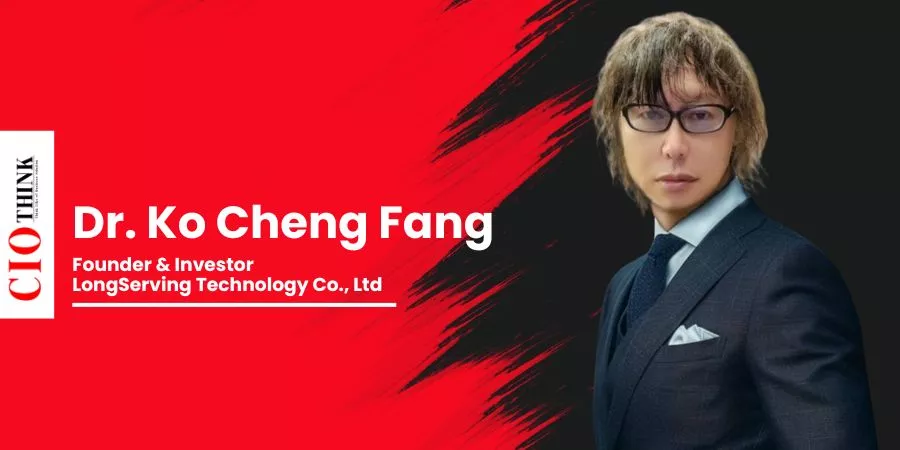
Painter, inventor, meditator, and patent-holder, Dr. Ko-Cheng Fang has spent a lifetime doing the impossible, quietly. Now he is about to do it loudly.
The Artist Who Rewrote the Laws of Physics and the Story Behind the World’s First 2-Nanometer Optical Material
From a Painter’s Studio to the Frontier of Quantum Computing: How One Visionary Is Reshaping Civilization
Dr. Ko-Cheng Fang | Founder, Chairman & CEO | LongServing Technology Co., Ltd., Taipei, Taiwan
There is a painting that started an argument. It shows a small girl and her dog, perhaps somewhere near the foot of the Alps, though the setting is deliberately ambiguous. The girl’s eyes hold a trace of mischief that her expression carefully conceals. Her gaze meets yours and then, somehow, does not. The dog beside her is calm, warm, a gentle counterweight to her contained restlessness. When Dr. Ko-Cheng Fang posted it on Instagram, his followers began calling him something he had never asked for: the Leonardo da Vinci of the East.
He laughs at the comparison, not dismissively, but with the ease of a man who has learned to hold large things lightly. He began drawing before he started elementary school. His childhood home smelled permanently of mineral spirits. Plaster casts of Venus and David stood in his personal studio. He studied traditional Chinese gongbi bird-and-flower painting before crossing into Western watercolor and oil. At his first outdoor competition, journalists surrounded him for interviews. A Japanese manga publisher visited Taiwan wanting to bring him to Tokyo for formal training. His family, sensibly, declined.
None of this explains why, a few decades later, he would become the man who solved one of the most stubborn problems in modern semiconductor science. But it might explain how.
THE LONGEST EXPERIMENT
The story of Dr. Fang’s emergence as a technologist begins not with a circuit or a laboratory contract, but with a gemstone. Imperial Green jadeite, the deep, silk-sheened green once treasured by Qing dynasty emperors and still visible behind museum glass in Taipei’s National Palace Museum had been geologically exhausted for decades. The substance is extraordinary in its rarity: tens of thousands of tons of raw ore might yield a single carat of the genuine article. Humanity had successfully synthesized every other major gemstone ruby, sapphire, emerald, diamond but Imperial Green jadeite remained stubbornly beyond reach. The world’s most concerted efforts, by General Electric in the United States and a leading research institution in China, had ended in failure.
Dr. Fang found this unacceptable. He began studying geology, gemology, inorganic chemistry, and ceramic glaze science. He built a personal lab at home, purchased instruments, ran experiments, failed, adjusted, and ran more. Thousands of them. Then tens of thousands.
“Without passion, 99.9 percent of people would have considered me mad. But passion sustained my momentum. There has been only one Jadeite Cabbage in all of history. This year, I plan to recreate it.”
He speaks about failure with an artist’s vocabulary, not as defeat, but as subtraction. “Life resembles sculpture,” he says. “You transform a rough stone into something beautiful. It requires carving away the excess, removing the waste, refining relentlessly in pursuit of perfection. My method is one of elimination: discard the inessential, preserve the essential. Remove ninety-nine failures to uncover a single success. Next time, perhaps it takes only ten.”
Eventually, after years of trials that most researchers would have abandoned, a crystal emerged from his studio that matched the color, transparency, and structure of natural Imperial Green jadeite. In 2024, he released the first commercial gem-grade laboratory-grown jadeite, an achievement that had eluded two of the most technologically advanced nations on earth. He treated the breakthrough as a beginning rather than a destination. If he could recreate a gemstone formed over billions of years beneath the earth’s crust, what else might be within reach?
THE INVISIBLE FOUNDATION
Somewhere in the early 2000s, Dr. Fang noticed that the internet was broken in a fundamental way. Computers crashed constantly. Viruses spread faster than defenses could contain them. Hackers operated with near-total impunity because security frameworks could only identify threats after the damage had been done, cataloguing the infection and hoping to prevent the next one, like a police force that always arrives after the robbery.
He designed something different: a cybersecurity framework that moved mobile databases to the cloud, creating a programmable password lock capable of detecting abnormal program changes and automatically restoring the system in the background before an intrusion could be completed. The logic was elegant, trap the attacker inside a virtual space, trace the breach in reverse, give defenders time to respond. He filed the cloud patent in 2002. The programmable lock followed in 2004.
The U.S. Department of Homeland Security adopted the platform for its counter-terrorism infrastructure. Dr. Fang contributed the invention without accepting a single dollar in licensing fees and kept the matter quiet for years. Today, over 4.6 billion people interact with the design he created every time they unlock an app, upload a file, or transmit data across a network, most of them entirely unaware that a painter from Taipei built the foundation beneath it.
Recognition did not follow. Instead, accusations did. He was labeled a patent troll, treated as a criminal, placed under surveillance. He says, with a flatness that communicates far more than drama would. “I chose not revenge, but creation. I chose to contribute more inventions to the world.”
“Success is not when the world understands your work. It is when the work survives long enough for the world to need it.”
The experience shaped a conviction that has guided him ever since: that the gap between invention and recognition is not a problem to be solved, but a condition to be endured with patience and continued output. He endured it. And he kept building.
THE PHYSICS PROBLEM
By the time Dr. Fang turned his attention to processors and semiconductors, the industry had built an enormous cathedral to a single element: silicon. TSMC had become Taiwan’s most powerful company, its “sacred mountain,” as the local press called it. Computing units had shrunk from microns to nanometers, generation by generation, in what the industry called Moore’s Law: a reliable doubling of transistor density roughly every two years.
That law was running out of room.
The problem is rooted in physics. Electrons, the particles that carry information through conventional circuits, travel through copper interconnects via a chain reaction, one colliding with the next, like dominoes falling in sequence. At nanometer scales, a phenomenon called quantum tunneling causes electrons to escape their channels entirely. Signals blur. The distinction between a 0 and a 1 — the entire foundation of digital computing, becomes unreliable. Meanwhile, the heat produced by billions of electrons moving through densely packed circuits demands ever-more-complex cooling systems, and the energy consumption of modern data centers has grown to rival that of small cities.
“Seven or eight years ago, I already saw this problem coming,” Dr. Fang says. “The core solution was to replace conventional processors with optical quantum units. Their computing capacity could be at least a thousand times greater, with far lower energy draw. But it seemed impossible. It challenged physical limits.”
The obstacle was wavelength. Photons, particles of light, behave fundamentally differently from electrons. They travel as waves at the speed of light, ignore electromagnetic interference, carry no charge, and generate almost no heat. The challenge was that light’s natural wavelength is enormous compared to modern circuit pathways. Silicon-based optical technology, the industry’s leading attempt at a solution, operates at wavelengths between 1,300 and 1,500 nanometers. Current circuit pathways sit at roughly 14 nanometers. That gap had kept optical computing confined to research papers and demonstration units for decades.
Dr. Fang took a different approach. Rather than forcing large-wavelength photons into narrow electronic channels, he asked a more fundamental question: could an entirely new substance be created that emitted light at a wavelength small enough to match?
“I turned to nanomaterials, developing photosensitive substances in the 2 to 3 nanometer range. When tested using Raman spectroscopy and X-ray diffraction, no existing spectrum matched the results. A new material had emerged.”
He named it X-Photon. Its average emission sits at 2 nanometers, small enough to interface directly with 14-nanometer circuit pathways, eliminating the conversion bottleneck that had held back optical computing for a generation. Patents now cover 26 countries, including the United States and the European Union. In 2025, he announced the substance publicly. In April 2026, he went further.
THE ARCHITECTURE REVEALED
On April 23, 2026, Dr. Ko-Cheng Fang published three diagrams on the LongServing Technology website. Each was drawn by his own hand. Together, they represent the first public disclosure of a complete optical quantum computing system, not a concept, not a simulation, but a fully documented design ready for fabrication.
The first diagram showed the 3D structure of the unit: the processor itself layered above an optoelectronic conversion base. The second revealed the full structural layout of the optical pathways, the routes along which photons travel through the circuit, reengineered into a 45-degree configuration that optimizes signal flow. The third demonstrated a photonic full-adder: the fundamental arithmetic building block of any computing system, rebuilt entirely in light.
What makes the design remarkable is what it eliminates. Conventional silicon processors require dozens of stacked fabrication layers. The LongServing unit achieves its full function in three: a bottom layer of optical memory, a middle layer of logic gates, and a top layer of signal pathways. Each is fabricated using a distinct photomask. The optical memory layer, itself a breakthrough, stores signals in their photonic form, performing electrical conversion only at the final output stage. This removes the repeated light-to-electrical-to-light translations that made earlier optical designs inefficient.
The performance implications are staggering. Computational speeds are projected at tens of thousands of times faster than conventional processors. Because data access occurs at the speed of light, the true ceiling of performance remains, for now, impossible to precisely quantify.
“I have learned to be patient with the gap between invention and understanding. The diagrams are published. The patents are filed. The performance demonstration will come. Facts prove everything.”
THE WORLD HE IS BUILDING
Dr. Fang’s ambitions do not stop at the processor. They extend, with the same methodical audacity, into biotechnology, fashion, and the long horizon of how civilizations transform.
In his biotech lab, plant-derived compounds have demonstrated the targeted destruction of cancer cells, including aggressive lung cancer (A549), liver cancer (Huh7), and malignant melanoma (A375) lines, under controlled conditions. The next step is nanotechnology-assisted probe injection to deliver these compounds directly into tumor cells, suppressing growth and blocking metastasis without the systemic damage of conventional chemotherapy. “Patients cannot afford prolonged delays,” he says. “Each year of waiting costs nearly ten million lives. Over a decade, that approaches one hundred million. Such a reality is neither reasonable nor humane.”
In 2026, LongServing made its first entry into fashion, handcrafted bags whose hardware incorporates laboratory-grown Imperial Green jadeite formed at temperatures above 1,400 degrees Celsius. Dr. Fang has also transferred his original paintings onto different accessories,creating a luxury collection that is, in his framing, simply another form of artistic output. “I have long been a patron of Chanel and Chopard,” he says. “I do not see this as competition. I see it as a tribute, an exchange of artistic taste.”
“The responsibility of an inventor is to contribute to an era, not to destroy a generation. Cooperation is better than conflict. That is why we invite existing foundries to transform alongside us rather than compete against them.”
He sees the next decade defined by intelligent humanoid systems with processing capacity a thousand times greater than anything currently deployed, working in networked teams across factories, hospitals, construction sites, and disaster zones. Humans, freed from physical labor, will redirect their energy toward intellectual and creative pursuits. “This is what sufficient processing capacity makes possible,” he says. “Conventional GPUs are not enough. Optical quantum processors are the foundation of that future.”
To reach it, he is not building a new factory from the ground up. He is inviting the world’s existing semiconductor foundries to evolve alongside him, adopting the optical process in parallel with their current capacity, using LongServing’s compounds and methods. It is the strategy of someone who understands that the fastest way to transform an industry is not to demolish it but to give it a better path forward.
THE MEASURE OF A LIFE
He is sitting very still now, the way a man sits when he is choosing words carefully, not because he fears being misunderstood, but because he respects the question.
“I hope my story shows the courage of an inventor,” he says. “To endure doubt, dismissal, and contempt without ever losing passion. If you are given a talent, you have a responsibility to use it for the benefit of the world. You may not be celebrated in your lifetime. You may be accused in your lifetime. But if the work is true, it will outlast every accusation.”
He thinks of Nikola Tesla, more than a hundred patents, the entire electrical framework of the twentieth century in his wake, and a rivalry with Edison defined by smear campaigns and deliberate marginalization. In the end, truth prevailed over reputation and financial power. “Geniuses like that are often lonely,” he says. “Fortunately, I am not alone.”
The people around him, the geologists, the chemists, the oncologists, the engineers — are all specialists in their domains. They implement his innovations. He supplies the cross-disciplinary synthesis. He attributes this capacity to something the scientific establishment is unlikely to footnote: meditation, practiced since childhood beneath a tree during school recess. Intuition sharpened to the point where he foresaw market collapses before they arrived, predicted a city district’s rise from empty land to Taipei’s most prestigious address, and, he says this with complete equanimity, carries memories of prior lives that give him access to knowledge impossible to accumulate in a single human span.
Whether or not one accepts the metaphysics, the outcomes are documented. The jadeite exists. The patents are filed. The design is published. The substance has been verified by spectroscopy. The processor blueprint is ready for fabrication.
“Technology defines humanity’s future. Without it, nations fall behind, economies stagnate, societies weaken. I chose to stand at the forefront of my time. That is the most important vision of my life.”
He was eight years old when he first felt time stop beneath that tree. He sat in the winter sun, focused on a single point, his body entering a strange and wonderful stillness while his classmates ran and shouted beyond the schoolyard fence. The bell eventually brought him back.
He has spent the decades since learning, with increasing precision, how to direct his attention when time stops. Into a canvas. Into a crystal. Into the behavior of photons at two nanometers.
Somewhere in Taipei, a substance that no spectrometer had ever catalogued before continues to emit its improbable light. Steady. Two nanometers. Quietly rewriting the coordinates of what is possible.
Dr. Ko-Cheng Fang did that.
Dr. Ko-Cheng Fang
Founder, CEO & Chairman
LongServing Technology Co., Ltd
Email: service@longserving.com.tw
Website: https://longserving.com.tw/en/
IG: @ko_cheng_fang
Also Read: Hall of Fame 2026: The Ones Who Made It