
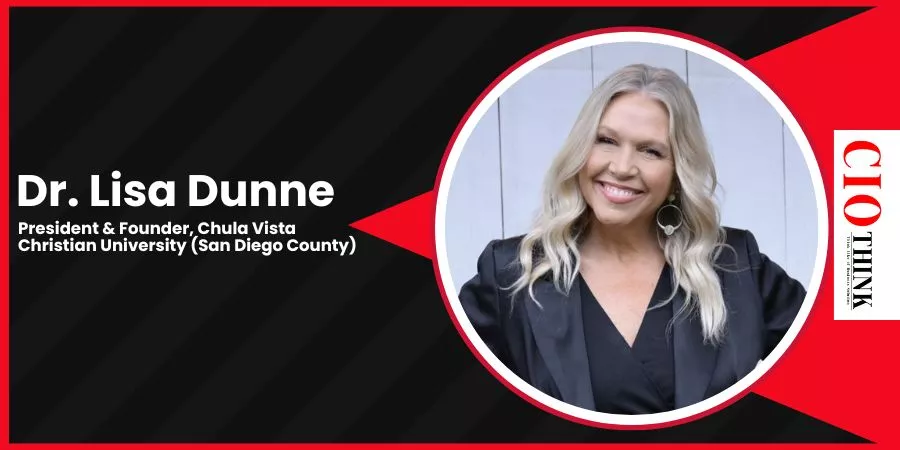
Dr. Lisa Dunne | President & Founder, Chula Vista Christian University (San Diego County)
There are moments in history when quiet observation transforms into bold action, when a single realization becomes the catalyst for systemic change. For Dr. Dunne, that moment did not arrive in a boardroom or through policy debate. It happened inside a classroom.
Standing before her students after more than two decades of teaching, she saw something deeper than academic struggle. She saw disconnection. Students who were present but not anchored. Engaged physically, yet drifting emotionally and intellectually. That moment revealed a truth she could no longer ignore, education was no longer forming individuals; it was processing them.
What began as concern quickly evolved into conviction. The system didn’t need adjustment. It needed reimagination.
From Observation to Educational Revolution
With over 25 years of experience spanning traditional classrooms and homeschool environments, Dr. Dunne developed a rare dual perspective, one that allowed her to compare not just outcomes, but human impact.
She witnessed firsthand the contrast between impersonal, standardized systems and personalized, relationship-driven learning models. The difference was undeniable. Students educated in environments rooted in connection, dialogue, and purpose consistently demonstrated stronger academic performance, emotional resilience, and personal confidence.
This wasn’t theory, it was evidence.
And from that evidence emerged a mission: to build an educational model that restores identity, fosters belonging, and prepares students not just for exams, but for life.
Education as a Rescue Mission
Dr. Lisa often describes her work as an “academic rescue mission” a phrase that captures both urgency and purpose. But what exactly are students being rescued from?
Not just failing systems, but deeper, more complex challenges: anxiety, disconnection, purposelessness, and what she identifies as “artificial attachment” a growing dependence on digital substitutes for real human connection.
In her view, these are not isolated issues. They are symptoms of a broader breakdown in relational structures, within families, communities, and educational environments.
Her solution is both simple and radical: restore connection.
Not through technology. Not through policy alone. But through intentional, multigenerational relationships that rebuild identity and purpose from the ground up.
Building a New Educational Ecosystem
Through her leadership at Chula Vista Christian University (CVCU) and the launch of 32 national homeschool academies, Dr. Dunne has translated philosophy into practice.
Her model challenges one of the most deeply ingrained structures of modern education, the classroom itself.
Instead of rows, there are circles.
Instead of lectures, there is dialogue.
Instead of passive learning, there is active participation.
This Socratic, dialogue-based approach transforms students from recipients of information into contributors of thought. It teaches them not just what to think, but how to think and more importantly, how to communicate, question, and engage.
In this environment, learning becomes relational. Identity is strengthened. Confidence grows.
And education becomes human again.
Understanding a Generation That Refuses to Be Standardized
Dr. Dunne’s work in Gen Z psychosocial development has revealed a critical disconnect between how modern students learn and how systems continue to teach.
Today’s learners are not motivated by authority, they are driven by relevance, connection, and purpose. Raised in an era of instant information, they no longer need access to knowledge. They need guidance in navigating it.
Traditional systems, built on industrial-era models, fail to meet this need.
Dr. Dunne’s approach addresses this gap by prioritizing two essential drivers of learning: efficacy and wonder. When students feel capable and curious, learning becomes intrinsic, not enforced.
And when students are heard, trusted, and given responsibility, they don’t just participate, they thrive.
The Power of Faith, Family, and Community
At the core of Dr. Dunne’s model lies a belief that education cannot be isolated from the structures that shape human identity.
Faith provides moral grounding.
Family provides relational security.
Community provides belonging and mentorship.
Together, they form a framework that cannot be automated or replaced by artificial systems.
Through CVCU’s initiatives, churches are being reactivated as centers of education—transforming underutilized spaces into thriving learning environments. These institutions do more than educate; they rebuild communities.
Students rediscover purpose.
Parents regain involvement.
Communities experience renewal.
It is not just an educational shift, it is a cultural one.
A Voice That Extends Beyond the Classroom
As a keynote speaker, author, and host of platforms like The Communication Architect and MindsetMatters, Dr. Dunne’s influence extends far beyond institutional walls.
Her message remains consistent across every stage and medium:
connection is the foundation of transformation.
In a world increasingly defined by noise and fragmentation, she brings clarity, reminding audiences that education is not simply about knowledge transfer. It is about formation.
Her communication expertise allows her to translate complex societal challenges into relatable, actionable insights. Whether addressing educators, policymakers, or parents, she speaks to a universal need, the need to belong, to be understood, and to contribute meaningfully.
Leadership Rooted in Courage and Compassion
Advocating for systemic change in a rapidly evolving cultural landscape requires both conviction and empathy.
Dr. Dunne acknowledges the challenges of leading in a secularized world, but she approaches them with a clear philosophy: courage must be guided by compassion, and conviction must be anchored in purpose.
Her leadership is not about opposition, it is about restoration.
She calls on educators to move beyond fear-based decision-making and instead focus on the future they are building. A future where students are not just informed, but transformed.
Redefining Legacy in Education
For Dr. Dunne, legacy is not measured in institutions built or accolades received. It is measured in lives changed.
It is found in families reconnected.
In students who rediscover purpose.
In communities that begin to thrive again.
Her vision is not limited to reform, it is generational.
She envisions a future where education becomes deeply personal, relationally grounded, and purpose-driven. A system where innovation and humanity coexist. Where students are not lost in the process, but discovered through it.
The Future She Is Building
As 2026 approaches, Dr. Dunne stands at the forefront of a movement that is quietly but powerfully reshaping education.
Not through disruption alone, but through restoration.
Not through complexity, but through clarity.
Not through systems, but through people.
In a world searching for answers, she offers something more enduring, a blueprint rooted in connection, purpose, and hope.
And in doing so, she is not just shaping the future of education.
She is reclaiming it.
Also Read: Visionary Keynote Speaker Shaping the Future of Education in 2026