

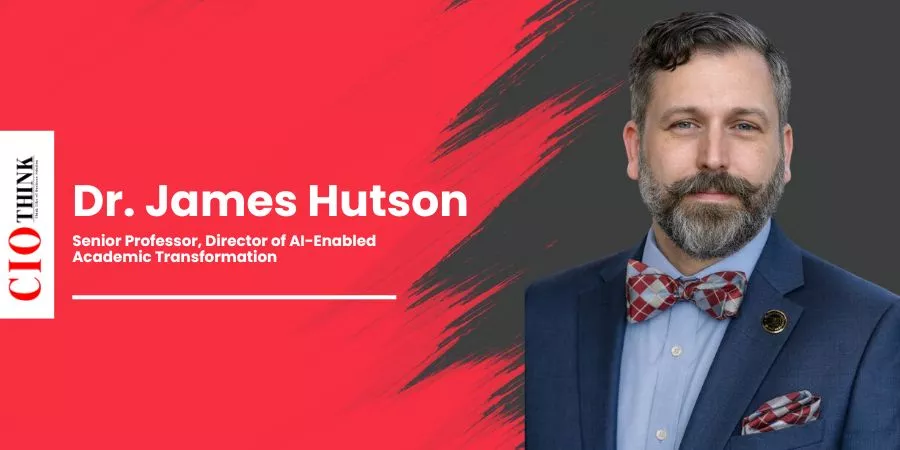
Dr. James Hutson is proving that the future of education will not be built by technologists or humanists alone, but by leaders fluent in both.
As Senior Professor and Director of AI-Enabled Academic Transformation at Lindenwood University, he is redefining what human-centered innovation actually requires.
Few academic leaders can claim expertise in both artificial intelligence and art history, and fewer still have built an entire career proving why that pairing matters. Dr. James Hutson holds doctorates in both fields. He treats the combination not as a curiosity but as a discipline in its own right, built on one conviction: technical innovation without human meaning is incomplete. As Senior Professor and Director of AI-Enabled Academic Transformation at Lindenwood University, Hutson has spent recent years turning that conviction into institutional practice, helping a university, and increasingly a much wider audience, navigate one of the most consequential shifts in the history of the classroom.
His path here was cumulative rather than linear. Long before generative tools became fixtures of daily campus life, Hutson was already testing how immersive technology could reorganize learning itself. He watched students who struggled with conventional lectures suddenly reason with precision inside reconstructed, interactive environments. The lesson stuck. Extended reality was not simply a new delivery platform. It was a different architecture for thought, built on spatial evidence and active investigation rather than passive absorption.
That insight now shapes work that reaches well past any one classroom. Hutson founded the Human-Centered AI and Interactive Technology Hub at Lindenwood to keep innovation tethered to educational values instead of scattering into disconnected technology purchases. Art history, computational method, and experiential design converge in his research the way they rarely do anywhere else in academia, backed by more than one hundred collaborators and a growing body of published work. His central claim cuts against easy assumptions: literacy in this new landscape is not prompt writing, and institutions that treat it as such will graduate students who are technically assisted but lack the judgment to use powerful systems responsibly.
As Editor-in-Chief of iJEDIE and an advisor to organizations including the Confluence Tech Hub, Hutson has watched the field move past whether technology belongs in the classroom toward a harder question: how immersive media, accessibility, and human agency get designed together as one coherent ecology. His consulting work insists institutions start with a defined problem, not a purchased product, and draw a hard line between tasks worth automating and decisions that still demand human deliberation.
Named among the Most Influential Leaders in Education in 2026, Hutson now links that institutional work to international efforts in workforce development, including collaborations with Zayed University in the United Arab Emirates and partners across Spain. His message to educators, though, stays plain. Skip the false choice between uncritical enthusiasm and defensive resistance. Bring curiosity, judgment, and evidence instead. The work is not to survive the change. It is to make sure a classroom, reshaped by machines, still teaches like it was built for people.
The Visionary’s Origin: Two PhDs and One Mission
- You hold PhDs in both Artificial Intelligence and Art History. How has this uncommon combination shaped the way you think about education, creativity, and innovation?
The combination has taught me to resist the artificial separation of technical innovation from human meaning. Art history trains one to examine context, interpretation, cultural power, visual rhetoric, and the long consequences of technological change; artificial intelligence adds computational reasoning, systems thinking, data literacy, and the capacity to prototype new forms of inquiry. Together, these disciplines compel me to ask not only whether a technology works, but also whose purposes it serves, what assumptions it encodes, and how it changes human agency. In education, that means treating creativity as a disciplined form of knowledge production rather than a decorative outcome. It also means designing innovation around judgment, ethics, accessibility, and human development instead of novelty alone.
- What moment made you realize that immersive technology was not just a tool for learning but a fundamental reimagining of what learning could be?
The turning point came through immersive work in which learners could enter reconstructed environments, manipulate spatial evidence, and encounter cultural material as active investigators rather than passive observers. I saw that students who struggled with conventional lecture formats could demonstrate sophisticated reasoning when knowledge became spatial, embodied, and interactive. That experience changed my understanding of the classroom. Immersive technology was not simply another delivery platform; it reorganized the relationship among learner, evidence, environment, and instructor. It allowed students to rehearse decisions, test interpretations, and learn through situated experience. From that point forward, I understood XR as a means of redesigning learning architecture, particularly for fields that depend on place, scale, movement, visualization, and experiential judgment.
- When did leading academic transformation stop feeling like a role and start feeling like a responsibility?
It became a responsibility when generative AI moved from a specialist technology into the daily lives of students, faculty, administrators, and workers. At that moment, institutions could no longer treat AI as an optional innovation project or a distant strategic concern. People needed practical guidance, ethical frameworks, institutional policy, and opportunities to build confidence without being shamed for uncertainty. I also saw how uneven access to expertise could widen existing educational and workforce disparities. Leadership therefore meant more than adopting tools; it meant helping communities interpret a historic transition, protecting human agency, and building structures that allow experimentation without abandoning rigor. Academic transformation became a responsibility because inaction would also shape outcomes, usually in ways that favored those who already possessed resources and technical confidence.
Human-Centered AI and the Hub He Built
- You founded the Human-Centered AI and Interactive Technology Hub at Lindenwood. What does “human-centered” actually demand of AI that most implementations completely ignore?
Human-centered AI demands that institutions begin with human purposes, capabilities, and consequences rather than with the tool itself. Most implementations ask, “What can this system automate?” A human-centered approach asks, “What should people continue to understand, decide, create, and be accountable for?” That distinction changes everything. It requires transparent governance, meaningful human oversight, accessibility, privacy protections, bias evaluation, and deliberate attention to neurodiversity and different modes of participation. It also requires institutions to examine how AI changes labor, identity, expertise, and trust. The Human-Centered AI and Interactive Technology Hub was built to connect research, curriculum, community engagement, and workforce development so that innovation remains accountable to educational values rather than becoming a series of disconnected technology purchases.
- You head AI programming, XR research, and Art History simultaneously. How do those worlds strengthen each other in ways most educators have never considered?
These fields strengthen one another because each addresses a different dimension of human learning. Art history provides cultural memory, interpretive rigor, and an understanding of how images and technologies shape societies. AI provides new methods for analysis, creation, simulation, and decision support. XR contributes embodiment, spatial cognition, and experiential access, while game design contributes systems of motivation, feedback, challenge, and agency. When integrated, they produce learning environments that are technically sophisticated and intellectually grounded. A student might analyze historical visual culture, enter a reconstructed environment, use AI to compare evidence, and then demonstrate understanding through an interactive experience. The synthesis prevents technology from becoming shallow, because every technical choice remains connected to context, interpretation, audience, and purpose.
- With 100+ research collaborators and publications, what is the finding from your work that the education industry most urgently needs to act on right now?
The most urgent finding is that AI literacy cannot be reduced to prompt writing. Sustainable transformation occurs only when institutions align human judgment, disciplinary knowledge, workflow redesign, governance, and continuous professional development. Across my research and collaborations, the same pattern appears repeatedly: people gain value from AI when they know how to frame problems, evaluate outputs, document decisions, recognize uncertainty, and determine when not to use the system. Education must therefore move beyond tool demonstrations toward epistemic literacy, which includes understanding how knowledge is produced, validated, challenged, and revised in AI-mediated environments. Institutions that act now should build these capacities across the curriculum and the workforce; otherwise, they risk producing technically assisted graduates who lack the judgment required to use powerful systems responsibly.
- What is the biggest mistake organizations make when they ask you to consult on AI integration?
The biggest mistake is beginning with a product rather than a problem. Organizations often purchase licenses, announce an AI initiative, and then ask employees to discover a purpose after implementation. That sequence produces confusion, duplicated effort, weak adoption, and understandable resistance. Effective integration begins with a clearly defined institutional or workforce need, followed by stakeholder analysis, risk assessment, workflow mapping, professional learning, and measurable outcomes. Leaders must also distinguish automation from augmentation. Some tasks should become faster, while others require deeper human deliberation. My consulting work therefore emphasizes readiness, governance, pilot design, and evidence collection before scale. The objective is not to make an organization appear technologically current; it is to improve human capability, service quality, learning, and decision-making in ways that can be demonstrated.
XR, Immersive Learning, and the Future Classroom
- Extended reality is transforming how students experience learning. Where is XR creating breakthroughs in education that traditional classrooms structurally cannot replicate?
XR creates breakthroughs when learning depends on experience that is otherwise impossible, unsafe, expensive, geographically distant, or ethically difficult to reproduce. Students can examine inaccessible cultural sites, practice complex procedures, visualize abstract systems, rehearse high-stakes decisions, and repeat experiences without the limitations of a single physical setting. XR also supports spatial and embodied forms of cognition that traditional text and lecture formats often underutilize. Its greatest value, however, is not immersion for its own sake. Effective XR connects experience to reflection, feedback, assessment, and transfer. When learners can act within a system, observe consequences, revise their approach, and then articulate what they learned, immersive environments become powerful laboratories for judgment rather than digital spectacles.
- Your mission is equitable, engaging, and innovative learning for all backgrounds. What is the equity gap in emerging technology adoption that most institutions are still refusing to acknowledge?
The most neglected equity gap is not simply access to devices; it is access to capacity. Two learners may have the same software and radically different opportunities to benefit from it because one has stronger digital literacy, more time, paid tools, mentoring, reliable infrastructure, and a culture that rewards experimentation. The other may face accessibility barriers, limited bandwidth, uncertainty about acceptable use, or fear that mistakes will carry disproportionate consequences. Institutions must therefore address training, support, representation, accessibility, and psychological safety alongside hardware. They must also involve affected communities in design decisions. Emerging technology becomes equitable only when people can understand it, question it, shape it, and use it to advance goals that they themselves recognize as meaningful.
- Game design sits in your background alongside AI and art history. What does game design understand about human engagement that formal education has consistently failed to learn?
Game design understands that engagement is designed through agency, feedback, progression, meaningful challenge, and visible consequences. Formal education has often mistaken exposure for learning and compliance for motivation. Games, by contrast, assume that people need clear goals, responsive systems, opportunities to experiment, and permission to fail productively. They calibrate difficulty, provide immediate information, and allow learners to see how individual decisions affect a larger system. Education should not become entertainment, but it can learn from these principles. A well-designed course makes progress legible, gives students consequential choices, and treats revision as part of mastery. Game design also reminds us that narrative and identity matter; learners engage more deeply when they can understand who they are becoming through the work.
Leadership, Publishing, and Industry Influence
- As Editor-in-Chief of iJEDIE, you define what counts as disruptive innovation in education. What idea submitted to that journal genuinely surprised you with how far ahead of the field it was?
What has surprised me most is not a single confidential submission, but the speed with which researchers are moving beyond the question of whether technology belongs in education. The most forward-looking work asks how AI, immersive media, accessibility, neurodiversity, and human agency can be designed together as an integrated learning ecology. Through iJEDIE, I have seen scholars treat learners not as recipients of innovation but as co-designers, critics, and knowledge producers. That shift is significant because disruptive innovation should not be defined by technical novelty alone. It should be evaluated by whether it expands participation, improves learning, challenges inherited assumptions, and creates models that others can adapt. The field is advancing fastest where educational research, design practice, and ethical reflection remain inseparable.
- You advise the Confluence Tech Hub and multiple companies on AI integration. What separates a leadership team that successfully adopts AI from one that buys it and never transforms?
Successful leadership teams treat AI adoption as organizational transformation rather than software deployment. They establish a shared purpose, assign responsibility, create governance, invest in professional learning, and make room for disciplined experimentation. They also communicate honestly about risks, labor implications, and the limits of current systems. Most importantly, they redesign workflows instead of adding AI on top of inefficient processes. Teams that fail usually delegate the initiative entirely to technology staff or isolated enthusiasts, then measure success by the number of licenses purchased. Through work with the Confluence Tech Hub, educational partners, community organizations, and industry, I have found that durable adoption depends on cross-functional ownership. Transformation occurs when leadership aligns strategy, culture, incentives, assessment, and human capability around a coherent objective.
Vision, Legacy, and the Standard He Sets
- You are recognized as one of The Most Influential Leaders in Education in 2026. What does influence in education actually mean when the technology changes faster than any curriculum can keep up?
Influence in education means building capacity that continues to operate beyond one person, one presentation, or one technology cycle. My work increasingly connects institutional transformation with broader national and international efforts in AI, education, and workforce development. Nationally, I contribute to initiatives involving community upskilling, small-business readiness, higher education transformation, GeoAI, regional innovation ecosystems, and partnerships that prepare learners and organizations for AI-enabled work. Internationally, I am developing collaborative research and educational partnerships with Zayed University in the United Arab Emirates and colleagues in Spain and other global contexts, with attention to responsible deployment, faculty development, and workforce transformation. This work has been possible because of the leadership and support of Dean Travis McMaken, Provost Kathi Vosevich, and President John Porter. Their willingness to support ambitious, interdisciplinary work has created the institutional conditions in which meaningful innovation can grow.
- To every educator watching AI reshape the classroom and wondering whether to lead the change or survive it, what does James Hutson tell them?
I tell educators that they do not need to choose between uncritical enthusiasm and defensive resistance. They need to lead with curiosity, disciplinary judgment, and evidence. Begin with the learning outcome or human problem, then determine whether AI strengthens the work. Pilot thoughtfully, document what changes, listen to students, protect privacy, and preserve the forms of reasoning that learners must be able to perform independently. At the same time, do not prepare students for a world that no longer exists. They need opportunities to use AI, question it, collaborate with it, and recognize its limits. The educator’s role is becoming more important, not less, because powerful tools increase the need for context, ethical discernment, mentorship, and standards. The goal is not to survive change; it is to shape change so that education remains deeply human.