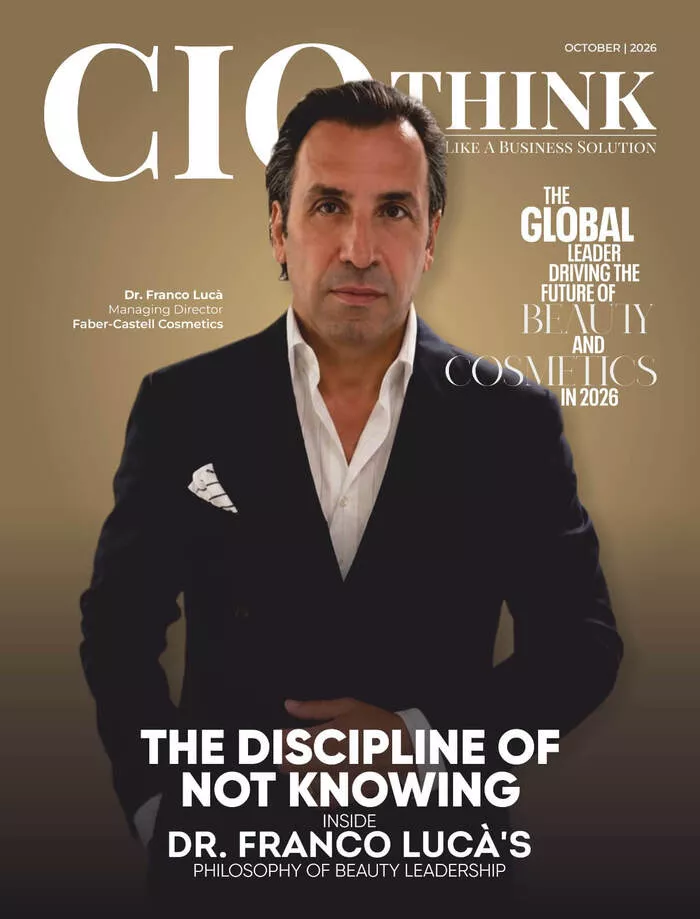

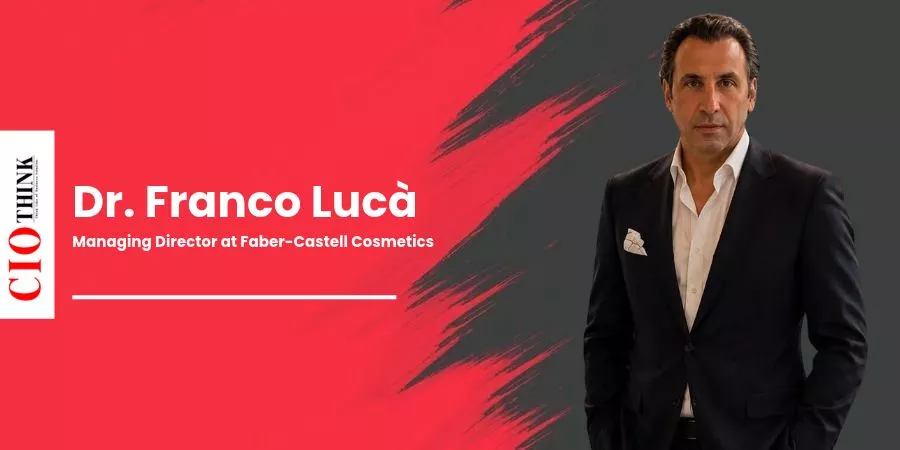
Across more than two decades spanning sales floors, boardrooms, and a global luxury brand launch, Dr. Franco Lucà built his career on a principle most leaders avoid saying out loud: you cannot predict the future, so build something that can survive being wrong about it.
As Managing Director of Faber-Castell Cosmetics, he continues to lead with a philosophy forged in uncertainty rather than forecasts.
What the Sales Floor Teaches That the Boardroom Never Can
Dr. Franco Lucà’s career began in sales across German-speaking countries and Italy, long before it carried him to Global VP and eventually President of a Beauty Division. It’s a starting point he credits with teaching him something no boardroom role could replicate. “Sales taught me that beauty is ultimately a business of people, trust and execution,” he says. “Before you can lead a market from a boardroom, you need to understand what happens when a customer says no, when a product does not perform as expected, or when a commercial promise cannot be delivered operationally.”
That early experience left him with a conviction that has shaped every decision since. “You cannot build a successful business by assuming that the future will simply look like an extrapolation of the past,” he explains. “Markets change. Customers change. Competitors emerge from unexpected places. A technology that seems marginal today can become transformational tomorrow.” Working directly with customers, he says, taught him to stay curious and prepared rather than overly confident in forecasts, a lesson he still returns to today: prepare for uncertainty, but do not pretend you can predict it.
Across leadership roles at Ing. Erich Pfeiffer GmbH, Heinz Glas, and GEKA GmbH spanning more than twenty years, Lucà is careful to name what actually connected those very different chapters. “The common thread has never been a title or a particular company,” he says. “It has been the ambition to create value and to leave an organization stronger than I found it.” Some chapters centered on international growth, others on operational excellence, innovation, or organizational transformation, but Lucà draws a consistent lesson from the pattern itself. “Careers, like companies, rarely develop exactly according to plan,” he reflects. “Some of the most important opportunities appear in places you did not anticipate. I have always tried to combine ambition with openness. You need a direction, but you also need the flexibility to recognize an unexpected opportunity when it appears.”
In 2008, Lucà became shareholder and CEO at GEKA GmbH, a shift he describes as fundamentally changing his relationship to time. “Ownership changes your time horizon,” he says. “When you have equity in a business, you naturally think beyond the next quarter or the next annual budget. You think about what the company will look like in five, ten or twenty years.” It also reshaped how he approached risk itself. “Organizations should not be designed around the assumption that extreme events are impossible simply because they have not happened recently,” he explains. “You cannot predict every disruption, but you can build resilience: financial discipline, strong customer relationships, diversified capabilities, adaptable teams and a culture capable of making decisions quickly.” Ownership, he says, reinforced a simple principle: you are not only responsible for optimizing today’s business, you are responsible for preserving the company’s ability to respond to tomorrow’s unknowns.
Crossing Into Luxury: Selling Meaning Instead of Capability
In 2013, Lucà made a significant leap, moving from beauty packaging into luxury leather goods to launch the Gianfranco Lotti brand globally. The shift demanded something his previous career had never required. “The biggest change was moving from selling capabilities to selling meaning,” he says. “In B2B, the value proposition can often be explained through performance, quality, innovation, reliability and economics. In luxury, those elements remain important, but they are only part of the equation. You are also selling identity, heritage, emotion, craftsmanship and aspiration.”
The transition reinforced a lesson that has stayed with him ever since. “Sometimes the greatest opportunities sit outside the boundaries you have defined for yourself,” he reflects. “Moving from beauty packaging into luxury required me to learn a new consumer psychology and a different language of value. It was uncomfortable in the best possible way. It forced me to question assumptions I had developed over many years. That is often where meaningful growth happens.”
Launching a global luxury brand, Lucà argues, comes down to a single decision that determines everything else. “The defining decision is the positioning,” he says. “Before you decide on distribution, communication, pricing or international expansion, you need to know exactly what the brand stands for, who it is for and why it deserves a place in that consumer’s world.” But he’s quick to add a second principle alongside it. “Do not confuse a strategy with a prediction,” he says. “A global launch inevitably contains unknowns. Consumer response, cultural differences, competitors and external events cannot all be forecast accurately. The objective is therefore not to create a plan that assumes nothing will change. It is to create a clear positioning and an organization capable of adapting when reality surprises you. That is the practical application of my mindset: strong principles, flexible execution.”
As President and CEO of BMB across luxury leather goods and luxury merchandise, Lucà has developed a clear view of what actually separates a brand that earns its positioning from one that simply claims it. “Consistency between promise and experience,” he says plainly. “A luxury brand cannot simply communicate exclusivity; the product, craftsmanship, service, distribution and customer experience all have to substantiate it.” Staying relevant, he notes, requires discipline as much as instinct. “Luxury also has to remain relevant without becoming reactive. Trends can appear suddenly, but a brand that follows every trend risks losing its identity. You need to distinguish between a temporary anomaly and a genuine structural change. A strong luxury leader has to know when to respond to disruption and when to stay disciplined and protect the long-term identity of the brand.”
What Academia Can’t Teach
Alongside his executive work, Lucà teaches marketing at the University of Applied Sciences in Ansbach and speaks at beauty industry conferences globally, giving him a distinct vantage point on the gap between classroom theory and the demands actually placed on beauty industry leaders. “Academia provides frameworks; business provides consequences,” he says. “Students need to understand positioning, segmentation, consumer behavior, pricing, brand architecture and the analytical foundations of marketing. But leadership requires something more: judgment.”
He’s candid about where traditional business education falls short. “Traditional business education can sometimes create the impression that every variable can be modeled and every outcome predicted,” he explains. “In reality, leaders operate with incomplete information. They have to make decisions while accepting that some events will be outside the model. I therefore tell students that data is essential, but humility is equally important. A model can improve a decision without eliminating uncertainty.”
As a frequent guest speaker across the beauty industry, Lucà points to a conversation he believes the sector keeps politely avoiding. “We need to talk more honestly about complexity, and about our attachment to predictability,” he says. “The beauty industry has accumulated enormous complexity across products, SKUs, markets, channels, regulations, supply chains and consumer expectations. At the same time, companies are under pressure to become more sustainable, more personalized, faster and more innovative.” That complexity, he warns, carries a hidden cost. “Complexity can create hidden fragility. The more interconnected a system becomes, the more difficult it can be to understand how an unexpected event will propagate through it. Leaders therefore need to ask not only, how do we grow, but also, where are we vulnerable. And perhaps most importantly: what should we stop doing?”
Where the Industry Is Underestimating Its Own Future
Looking at a beauty and cosmetics industry being reshaped in 2026 by sustainability, ingredient transparency, and AI-driven personalization, Lucà believes the most significant opportunity sits somewhere most leaders aren’t yet looking. “I believe the opportunity lies at the intersection of technology, trust and resilience,” he says. “AI can make beauty more personalized, efficient and responsive. Data can help companies understand consumers at an unprecedented level. Sustainability can create better products and more resilient supply chains. But the biggest impact may come from something we are not currently discussing.”
That conviction shapes how he advises leaders to build strategy at all. “Leaders should avoid building strategies exclusively around today’s visible trends,” he says. “AI, sustainability and transparency are important, but we should simultaneously ask: what assumptions are we making about the next five years, and what happens if one of them is completely wrong? The strongest organizations will not necessarily be those that predict the future most accurately. They will be those that can benefit from unexpected opportunities and absorb unexpected shocks. In other words, the goal is not to predict everything. It is to build a business that can survive one, and potentially benefit from the opportunities it creates.”
The Legacy He’s Building
Asked what he hopes the brands he built, the partnerships he created, and the leaders he shaped will say about his contribution to global beauty and luxury, Lucà’s answer moves beyond metrics entirely. “I would want them to say that I stood for people, performance, integrity and the courage to embrace uncertainty,” he says. “Business results matter. Growth matters. Innovation matters. But sustainable success is created by people who trust one another, understand what they are trying to achieve and are prepared to take responsibility for the outcome.”
The lesson he most wants to leave behind circles back to the same philosophy that has carried through his entire career. “We should never become prisoners of our own forecasts,” he reflects. “The future will inevitably surprise us. We cannot control every unexpected event, but we can control how prepared we are, how quickly we respond and whether we have built organizations capable of turning uncertainty into opportunity.” If he can look back knowing he helped companies grow stronger and helped people become better leaders, he says that alone would be meaningful. “Ultimately, I do not want to be remembered simply for the positions I held or the numbers we achieved. I would rather be remembered as someone who created momentum, developed people, built resilience and had the courage to lead when the path ahead was not entirely visible.”