
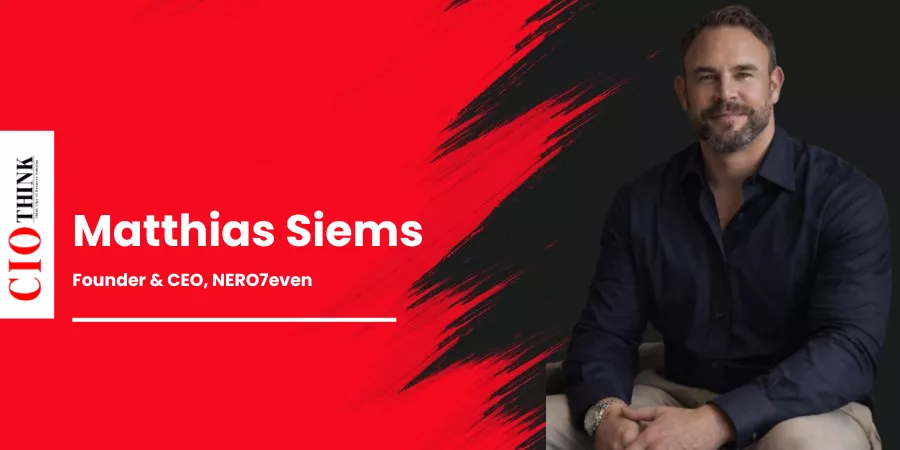
In an era crowded with rapid disruption, speculative promises, and technological noise, Matthias Siems operates from a different frequency. He is not interested in chasing trends or accelerating instability. Instead, he builds what endures. Trained in aerospace physics and holding more than 200 patents across sovereign energy, medical high-tech, and autonomous systems, Siems represents a rare class of visionary, one who understands that the future is not invented by ideas alone, but by systems that continue to function long after their creator steps away.
For Siems, innovation is not performance. It is structure. It is not velocity. It is stability under pressure. And as 2026 approaches, his work stands at the intersection of physics, psychology, and long-term global resilience.
From Scientist to Architect of Futures
There is a moment every deep innovator encounters, a quiet internal threshold where knowledge is no longer enough. For Siems, that realization arrived when he understood that physics can explain reality, but only applied systems can change it. Equations may describe the universe, yet it is functioning infrastructure, energy systems, medical technologies, autonomous platforms that determines whether societies flourish or fracture.
That insight marked his transition from scientist to builder of futures. His focus shifted from understanding how the world behaves to designing structures that shape how it endures. This philosophy would later define both his inventions and his investment approach: long-term coherence over short-term disruption.
Redefining Innovation in an Age of Noise
With more than 200 patents to his name, Siems defines true innovation in stark contrast to prevailing narratives. For him, innovation is reduction, not escalation. The most powerful solutions eliminate unnecessary complexity, simplify systems, and increase autonomy.
In physics, elegance emerges when fundamental laws are respected. In human systems, innovation succeeds when clarity replaces chaos. Technologies that cannot remain stable technically, economically, and psychologically, are not progress; they are variation without direction.
This lens explains why Siems is deeply selective, both as an inventor and as a venture capitalist. He does not invest in ambition alone. He invests in coherent realities systems capable of surviving scrutiny, market pressure, and human behavior.
The Responsibility of Shaping Global Systems
Few innovators openly acknowledge the weight of responsibility that accompanies frontier technology. Siems does. Any system intervention, he believes, produces feedback effects. Innovation that creates dependency eventually destabilizes societies. Innovation that builds resilience strengthens them.
For this reason, humility is not optional in his work, it is structural. Every technology he supports is designed to increase freedom rather than control, autonomy rather than reliance. This ethical grounding is not a philosophical add-on; it is a stabilizing force that determines whether systems endure or collapse over time.
Risk, Patience, and Long-Term Value
Siems’ scientific training deeply informs how he evaluates risk. In physics, risk is probabilistic, not emotional. He applies the same logic to investment decisions. Long-term value, in his view, emerges where systems remain functional under extreme technical, economic, and human stress.
Speed rarely outperforms patience. Markets reward momentum in the short term, but history favors technologies that quietly persist. This disciplined perspective has positioned Siems not as a speculative investor, but as a custodian of future viability.
TAP Technology: Engineering Energy Sovereignty
Among Siems’ most notable breakthroughs is TAP Technology, often described as a paradigm shift in energy systems. Yet the problem it addresses is not simply energy generation it is dependency.
Modern energy infrastructures remain tethered to fuel supply chains, weather volatility, and geopolitical leverage. TAP follows a fundamentally different physical approach. By organizing permanent magnetic fields as active mechanical drivers, it enables continuous motion and electricity without extraction in the traditional sense.
This is more than an engineering breakthrough; it is a psychological and structural shift from consumption to durability. In an increasingly unstable world, endurance becomes the highest form of progress.
From Concept to Reality: Overcoming Cognitive Resistance
Bringing TAP from theory to reality was not primarily a technical challenge. It was a cognitive one. Systems that contradict established models often face resistance, not from physics, which adapts quickly, but from markets and institutions anchored in familiarity.
This reality made rigorous validation essential. Disciplined testing, scientific transparency, and patience allowed the technology to speak for itself. In time, coherence prevailed over skepticism.
Energy Independence as a Catalyst for Stability
Looking ahead, Siems envisions TAP enabling nations to produce energy locally, continuously, and independently. This transformation does not announce itself loudly, yet its implications are profound. Energy stability reshapes power structures without conflict. And psychologically, stability creates the foundation upon which innovation, prosperity, and peace can grow.
The Evolution from Inventor to Visionary Tech VC
Transitioning from inventor to investor reshaped Siems’ perspective. Inventors solve problems; investors must design timelines. He does not back ideas. He backs systems that can survive reality.
When evaluating early-stage deep-tech ventures, he looks for two non-negotiables: physical coherence and psychological maturity. Teams must demonstrate intellectual honesty, ethical stability, and adaptability. Ambition without discipline is irrelevant.
This distinction defines what separates a visionary tech VC from a traditional investor. Capital is merely a tool. Stability is the objective.
Where the Next Decade Will Transform Most
By 2030, Siems expects the most radical transformation where physics, biology, and artificial intelligence converge, particularly in energy systems, medical high-tech, and autonomous platforms. These sectors will not be shaped by novelty, but by solutions that deliver measurable human benefit.
Innovation, in his framework, must serve people not narratives.
Ethics, Trust, and the Future of Collaboration
Ethics plays a central role in Siems’ philosophy. Systems without ethical grounding eventually fail, regardless of technical sophistication. This belief extends to how sovereign nations and private innovators collaborate. Trust matters more than control. Governments provide structure and legitimacy; innovators provide solutions. When mutual respect exists, progress accelerates sustainably.
Silence as a Strategic Tool
In a world addicted to constant output, Siems maintains an unconventional discipline: silence. He believes the most valuable insights emerge when noise is removed. Continuous stimulation clouds judgment; clarity requires space.
This practice allows him to continually challenge his own thinking and remain aligned with first principles both scientific and human.
A Legacy of Quiet Stability
When asked what he hopes his work will be remembered for, Siems does not speak of fame or disruption. He speaks of technologies that quietly increase freedom, resilience, and long-term stability.
As 2026 unfolds, shaping the future of innovation means designing systems that function even without their creator. That, for Matthias Siems, is the highest form of sustainability and the truest measure of visionary leadership.
In a time defined by speed, he chooses endurance.
In an era of noise, he builds coherence.
And in a world searching for direction, he designs futures that hol