
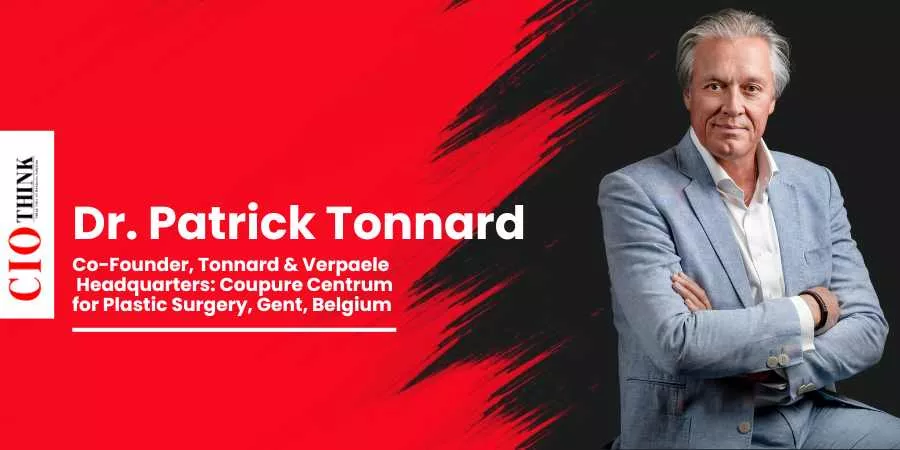
In an era where aesthetic medicine is increasingly driven by trends, filters, and fast fixes, Dr. Patrick Tonnard stands as a rare voice of precision, restraint, and authenticity.
With more than three decades of surgical excellence, the co-founder of Tonnard & Verpaele, based at the renowned Coupure Centrum for Plastic Surgery in Gent, Belgium, has redefined facial rejuvenation, not as transformation, but as restoration. His philosophy is rooted in a simple yet profound belief: true beauty lies in preserving identity, not altering it.
While the industry continues to chase artificial perfection, Dr. Tonnard quietly champions a more enduring vision, one that blends science, artistry, and deep human understanding. From pioneering regenerative approaches such as nanofat to advocating ethical, patient-centered care, his work continues to shape the future of aesthetic medicine at a global level.
Recognized as “An Iconic Personality Shaping the Future of Facial Rejuvenation in 2026,” Dr. Tonnard represents a new standard of excellence, where innovation is guided by integrity, and results are defined not by change, but by harmony.
Dr. Tonnard, you describe aesthetic surgery as a pursuit of balance rather than transformation. How did this philosophy shape your approach to facial rejuvenation?
My main focus in aesthetic surgery is rejuvenation. It is of utmost importance that the changes I create through intervention move in the direction of how the patient looked at a younger age. In my country, although cultural differences may exist, people generally do not want to change or lose their personal identity. This principle also applies to other procedures such as rhinoplasty or mommy makeovers. Most patients seek natural results that align harmoniously with their personality.
Over more than three decades, what has remained constant in your vision of aesthetic medicine, and what has evolved?
What has remained constant is my ethical integrity and respect for the patient’s perspective. Over time, I have learned to listen more carefully and to judge less. However, when patients request procedures that I cannot or do not want to perform, I am transparent and may refuse treatment. Today, about 20% of my patients are not treated due to incorrect or insufficient indications. This is particularly common among younger patients influenced by social media trends, who request changes I do not feel comfortable performing. Occasionally, this leads to negative reviews, but I accept that. It is better than performing a procedure that I know will not benefit them in the long term.
What has evolved significantly is surgical technique. I increasingly incorporate regenerative approaches using living cells rather than synthetic materials like fillers. We are witnessing the rise of regenerative medicine, which will fundamentally transform the field of aesthetic medicine.
What does being recognized as “An Iconic Personality Shaping the Future of Facial Rejuvenation in 2026” mean to you?
It is a great honor to receive such recognition, but awards mainly serve the ego. True satisfaction comes from daily practice and seeing grateful patients. Witnessing a patient transform not only physically, but also mentally and energetically, is the real motivation that drives me forward.
You emphasize harmony, proportion, and natural expression. How do you translate these abstract concepts into precise surgical outcomes?
Our profession represents a unique combination of science, primarily anatomy, physiology, and biology, artistry, and psychology. We are sculpting living tissues, working within constraints such as blood supply, innervation, and healing capacity. Ultimately, the goal is a satisfied patient. Even the most technically perfect result is a failure if the patient is unhappy. This is where psychology becomes essential, and also why I sometimes refuse surgery. The artistic dimension is equally important: aesthetic harmony is not defined by strict measurements, but by balanced proportions.
In a field often driven by trends, how do you maintain a timeless and patient-centered approach?
I recently created a viral reel with over one million views that addresses this (https://www.instagram.com/reel/DUoJlunk_JX/). It is titled “Stop Treating Your Face Like a TikTok Trend.” The aesthetic industry often promotes products with limited scientific evidence behind their marketing. Remaining loyal to scientific principles and proven techniques is far more sustainable than following temporary trends that quickly become outdated.
What role does deep anatomical knowledge play in achieving results that look both natural and enduring?
A deep understanding of anatomy is fundamental in any surgical procedure. Trends may change frequently, but anatomy remains constant. I would add a second essential science, particularly in rejuvenation: biology. A better understanding of the biological processes of aging allows us to achieve more durable and natural results. Well-performed rejuvenation surgery that respects both anatomy and biology often outperforms non-invasive treatments such as fillers or energy-based devices. In fact, such surgery can be less invasive and less destructive than many so-called “non-invasive” alternatives.
You often say that “less is more.” How do you determine when restraint is the best decision for a patient
This is fundamentally a question of the benefit-to-risk ratio. If a desired result can be achieved with a simpler intervention, there is no reason to complicate matters. Throughout my career, I have aimed to simplify surgical techniques without compromising effectiveness. I typically spend 3 to 4 hours on a full facelift, whereas some surgeons may take up to 12 hours. I do not believe their results are proportionally better. By focusing on the essence of the procedure, much unnecessary complexity can be eliminated. Many practices are based on habit or myth, and it is often challenging to reduce treatment to exactly what is needed.
You believe every patient carries a story. How do you ensure that your work reflects their identity rather than altering it?
This is a complex question. When a patient enters my consultation, within the first seconds I ask myself: “What does this face communicate?” I try to identify a single emotion, such as sadness, fatigue, or tension, and briefly note it. During the consultation, patients often explain their motivations, and this initial impression is usually confirmed. We then review photographs from when the patient was between 20 and 30 years old. In most cases, we observe that their emotional expression has changed over time. Restoring that earlier emotional expression is often exactly what patients are seeking. This is why I always include the eyes and mouth in the treatment plan, they are central to emotional expression. A facelift that ignores these areas becomes a purely mechanical tightening procedure and does not truly enhance patient satisfaction. Recognizing one’s former self can have a profound effect.
Trust is central to your practice. How do you build honest and transparent relationships with your patients?
By being genuinely honest and transparent. Patients recognize authenticity. I discuss all possible complications, even those I have never encountered, not to create fear, but to educate. When patients are well informed, fear often turns into trust. If a patient is too young for a facelift, this is clearly communicated. Sometimes reassurance alone, hearing that they look fine and can postpone surgery, already improves their well-being. When complications arise, such as delayed healing or swelling, I provide increased attention and follow-up. Some surgeons avoid these situations, but patients are highly sensitive to that. Extra care during difficult moments is deeply appreciated and often strengthens trust.
Have there been moments when saying “no” to a procedure was the most powerful form of care you could offer?
We are not a supermarket offering procedures on demand. Every surgery must be based on proper indications. In aesthetic surgery, patients initiate the request, but without the correct indication, the outcome will not be satisfactory. A lip lift is a good example: it is effective when the upper lip lengthens with age and covers the upper teeth, altering expression. However, younger patients, often influenced by social media, may request this procedure without indication. In such cases, the results can be disastrous.
What emotional or psychological transformations have you witnessed when patients reconnect with their natural selves?
These transformations can be remarkable. Patients may change not only physically—through hairstyle, clothing, or makeup—but also mentally, with increased self-esteem. Partners who were initially skeptical often change their perspective when they see how the patient has evolved. Many patients adopt healthier lifestyles and take better care of themselves. I recall a 65-year-old patient whose facelift was postponed due to abnormal liver tests, leading to a diagnosis of early cirrhosis. This prompted her to stop drinking entirely. Six months later, she underwent surgery with excellent results. Now in her 80s, she remains in great health and still visits for minor treatments. She never developed full cirrhosis.
How do you see the concept of beauty evolving in today’s world, especially with the influence of social media and unrealistic standards?
One of my main concerns is the over-commercialization of aesthetic medicine. Social media often promotes filtered and manipulated images to attract patients. The industry frequently communicates half-truths that are accepted without critical analysis. While profit is not inherently problematic, it becomes concerning when patient well-being is compromised. In my practice, about half of the facelift patients have previously undergone filler or energy-based treatments. We often encounter fibrotic nodules or altered fibrotic tissue planes, which complicate safe surgery. Fillers may also carry bacterial biofilms that can trigger inflammation. This is becoming increasingly common, especially as such treatments are promoted at younger ages.
What misconceptions about facial rejuvenation would you most like to challenge?
The biggest misconception is that shortcuts can replace comprehensive facial rejuvenation. This reflects a broader culture of instant gratification. The industry profits from promising solutions to aging without surgery, but many of these treatments yield mediocre results. Patients often turn to surgery after multiple non-invasive procedures. Unfortunately, these treatments can damage soft tissues. Fillers may induce excessive collagen formation, often labeled as “regeneration,” but in reality a form of scar tissue. Energy-based devices can destroy fat and denature proteins, leading to fibrosis. These are repair mechanisms, not true regeneration.
Looking ahead to 2026 and beyond, what innovations or shifts do you believe will redefine the future of facial rejuvenation?
The future of rejuvenation lies in regeneration. Regeneration is a natural biological process that occurs continuously in the body. Some species can even regenerate entire limbs, indicating that these mechanisms already exist. Our role is to understand and harness them. There may come a time when surgery is no longer necessary for rejuvenation. This will depend on deeper insights into biology and working with, rather than against, natural processes. We are already seeing early applications with fat-derived stem cells, such as nanofat. Future treatments will rely less on pharmaceuticals and more on cellular therapies, leveraging the body’s inherent intelligence developed over millions of years.
Another major shift will be from reactive to proactive medicine. Today, we treat disease after it appears. In the future, we will aim to prevent or delay its onset. Advances in biology, AI, and computational power will accelerate this transition.
When you reflect on your life’s work, what legacy do you hope to leave in the field of aesthetic medicine and in the lives of your patients?
With the introduction of nanofat in 2013, we contributed to the development of regenerative medicine, particularly in aesthetic skin treatments. However, the broader impact of regeneration will be in musculoskeletal medicine, which affects the entire population. Aesthetic medicine represents only a small fraction of patients, whereas degenerative conditions are universal. I hope our work serves as a catalyst for the wider field of regenerative medicine, as I am convinced that regeneration will define the future of healthcare.
Closing Note:
Dr. Patrick Tonnard’s work reminds us that true innovation is not always about doing more, it is about doing what matters, with precision, integrity, and purpose.
In a world chasing artificial perfection, he continues to redefine beauty as something far more powerful:
authentic, balanced, and deeply human.Top of Form
Also Read: An Iconic Personality Shaping the Future of Facial Rejuvenation in 2026